
The Kansas Build
A BAAI Report - October 2026
Executive Summary
Section I
Picture a county commission meeting in Kansas on a Tuesday morning. Before the commissioners is an opportunity to bring thousands of jobs, significant investment, and decades of economic growth to their community through a new data center campus. The project promises to help power the AI economy while creating lasting benefits for local residents and businesses. Realizing that promise means getting a few important things right: understanding the project’s needs for water, power, and workforce; ensuring infrastructure investments are shared fairly; and establishing a clear, predictable timeline for decisions. With the right framework in place, Kansas communities can welcome transformative investment, protect local interests, and position themselves to capture the full benefits of the AI economy.
The AI economy is arriving in Kansas via freight, heavy industry, and infrastructure construction. It lands as switchgear on flatbed trucks, as substation steel, miles of cooling loop, and conduit. It is licensed physical work done by hand that pays locals well above the Kansas median. The state has recorded 77,800 construction jobs as of August 2026, the highest reading in the seasonally adjusted federal series since it began in 1990, an increase of 14,600 jobs, or 23.1%, from August 2019.1
Kansas has the workers, the power, and the industrial base to build for the AI economy. And while it has the capacity for industrial expansion, it lacks a dependable way to consider these projects. This is an important distinction because, while the private sector is poised to move forward, the public permission structure at the local level has sometimes proven confusing to taxpayers. This is a problem of governance, as it prevents meaningful policy debate concerning the impact of data center construction.
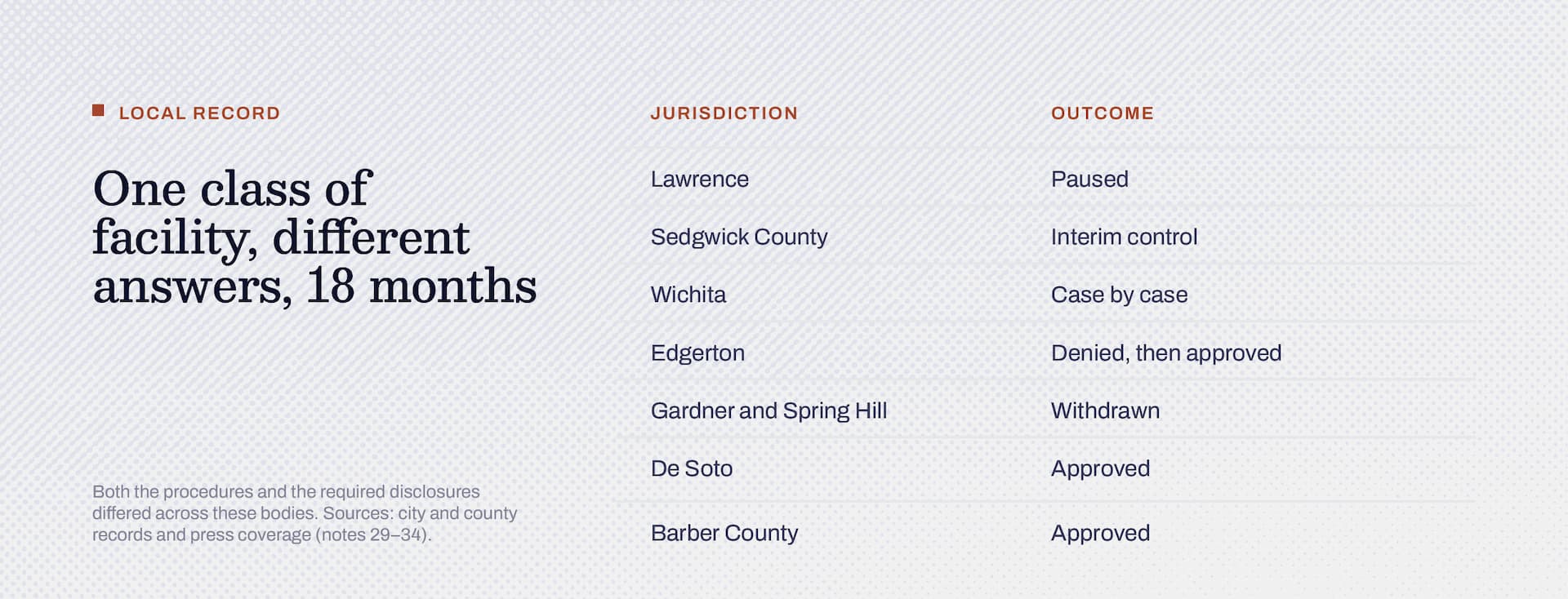
In the past 18 months, a number of Kansas communities reached wildly divergent answers to the same construction application on wildly different bases. Lawrence paused new filings while it considered code changes. Sedgwick County imposed an interim control. Wichita continued to review case by case. Edgerton’s planning commission denied a project, but the city council later approved it on appeal. De Soto and Barber County approved theirs.2 Across Kansas, the same class of facility is met with different procedures, different disclosure demands, and different timetables depending on its address. That divergence is a function of missing common rules, and in such a vacuum, two things are clearly true: first, each town pays to reinvent the wheel as a matter of process; and second, firms seeking to drive growth in the state face a great deal of uncertainty that negatively affects ongoing investment decisions.
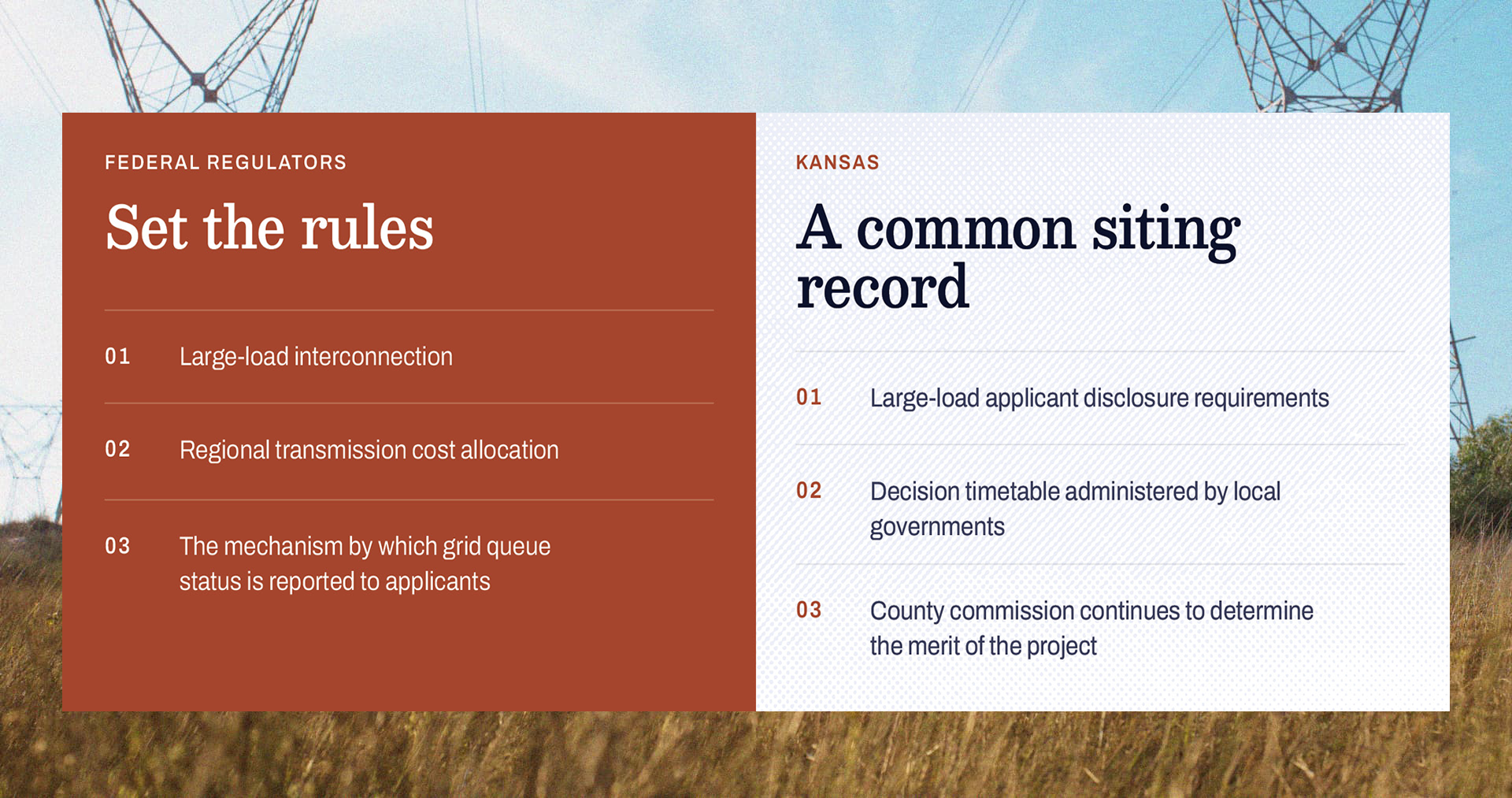
The good news is that we are still early in this new industrial revolution, and there is time to sort these issues out. As of October 2025, 67% of manufacturers surveyed across the Federal Reserve’s Tenth District said AI had not affected their strategy or plans at all.3 Although that result describes the seven-state region, not Kansas alone,4 the point stands. The build-out supporting this new physical AI economy is happening ahead of, and will partly pull along, the change inside existing plants.To ensure that the state is well-positioned to avail itself of the coming wave of investment, Kansas needs reforms, one at the federal level and one at the state level. Federal regulators need to set the rules for large-load interconnection, for how regional transmission costs are allocated, and for how the grid queue status is reported to applicants. FERC regulates interstate transmission service and wholesale power markets, so federal rules should govern large-load access within that jurisdiction. Kansas, for its part, should establish, as a baseline, a common siting record. This would include what a large-load applicant must disclose and a decision timetable local governments administer. The choice on the merits stays where it belongs, in the hands of the county commission that will live with the substation and the water line for decades. In this way, a common rule for project paperwork would not constitute an abrogation of local authority but would hasten the evaluation of proposals of state and regional concern while allowing communities to compare filings made in one area with those of another.
77,800
Kansas construction jobs, as of August 2026, the highest reading in the seasonally adjusted federal series since it began in 1990
+14,600
jobs, or 23.1% from August 2019
FRED, All Employees: Construction in Kansas (KSCONS), note 1
67%
of manufacturers surveyed across the Federal Reserve's Tenth District said AI had not affected their strategy or plans at all, October 2026
Seven-state region, not Kansas alone. Federal Reserve Bank of Kansas City, notes 3-4
What is being asked
Section II
Build-Out and its Complications
Data center projects are matters of public concern because of their sheer physical scale and economic impact. The centers themselves are heavy industrial buildings that require intensive excavation and grading, structural steel, high-voltage electrical work, switchgear installation, piping, controls, and fire suppression. On the labor front, the trades involved in making this happen are part of skilled occupations whose members enter their profession through licensing, apprenticeship, or employer training. Notably, they are the same people who will live with the data center project in their area. The construction phase of a data center project is an important early point for assessing local economic impact, but it is not the endpoint. Between all these various considerations, the challenge for local government in assessing projects is not insignificant. When processes are confusing, resentment grows.
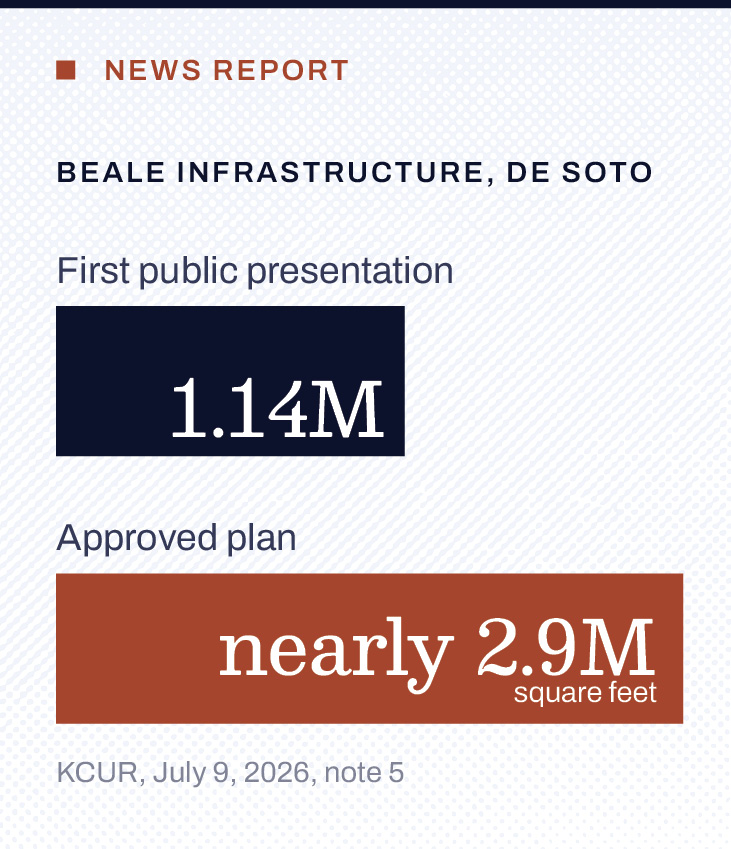
To successfully develop projects, the public needs a process that it believes is both honest and capable of delivering on its promises. The saga of Beale Infrastructure’s De Soto project, in the Kansas City metro area, demonstrates how communities can stop assuming good faith. The first public presentation for Beale described a concept of about 1.14 million square feet that the company was careful to note was not part of its formal application. The approved plan instead reached nearly 2.9 million square feet. One resident called the change “a breach of understanding.” Another came looking for power-and-water answers and found balloon artists at the meeting.5 Crucially, nothing in Kansas law requires a first presentation to match its final application. Thus, the public reasonably felt it had been sold a bill of goods.
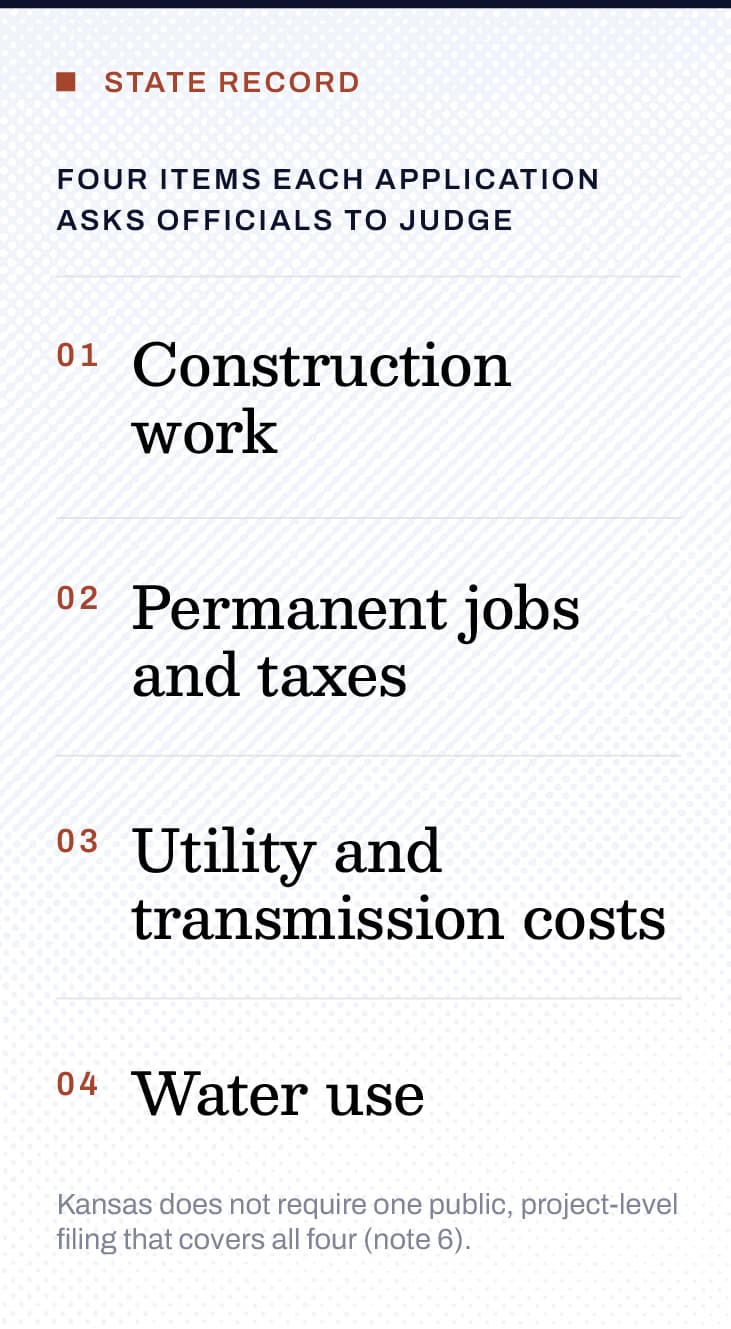
In general, each application asks officials to judge four things: the construction work, the permanent jobs and taxes, the utility and transmission costs, and the water use. Kansas does not require one public, project-level filing that covers construction employment, permanent jobs and local tax payments, utility and transmission-upgrade costs, and projected water withdrawal and consumption.6 Thus, applicants disclose different figures, at different times, to different bodies. Moreover, residents have no benchmark against which to compare one offer with another, because each offer is delivered in pieces and is timed around the applicant’s own schedule. The structure of the process essentially guarantees that the public is kept confused, and approval resembles the granting of concessions.
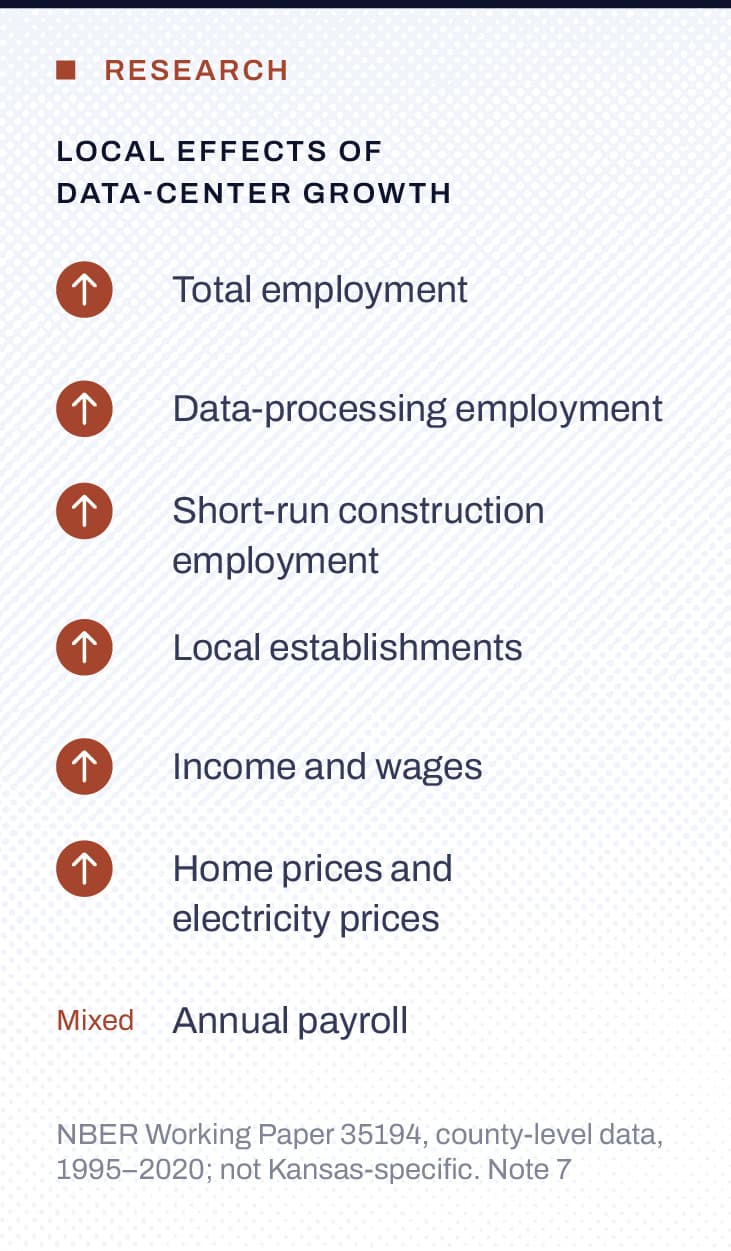
But for any given community, the build-out of a data center can become a valuable local resource. A 2026 analysis by the National Bureau of Economic Research, relying on county-level data and shift-share instruments to estimate the local effects of data-center growth, finds that build-out increases total employment, data-processing employment, short-run construction employment, local establishments, income, wages, home prices, and electricity prices. Construction employment rises strongly during the early build-out, while annual payroll responds with more mixed effects. And construction effects are strongest in the short run, while operating-phase effects vary by outcome.7 The paper covers 1995 through 2020 and is not Kansas-specific, but it contains important general lessons even before AI interest drove the current build-out demand to previously unseen levels. What a county buys with permission is a building boom, and what it gets afterward is a building that needs power, water, and hundreds of people to manage it.
A jurisdiction that says yes to a data center is, in essence, approving an industrial plant. Where early construction creates an initial employment surge, the permanent jobs and taxes come over the medium and long term, accruing to the county’s benefit. Not every project is guaranteed to generate the same level of benefit, but its potential benefits can be evaluated more effectively if presented in a predictable process supported by transparent requirements that develop a common record.

Why Kansas is worth a yes
Section III
Supply and Application Evidence
A successful data center project is only as good as the surrounding industries and labor pool that support it, and this is where Kansas’s key contribution exists. Kansas is home to the skilled trades, technical colleges, applied research, and the comparatively stable power that a data center project demands. Thus, it is the path to permission, not the core industrial capacity, that is the primary constraint in these projects.
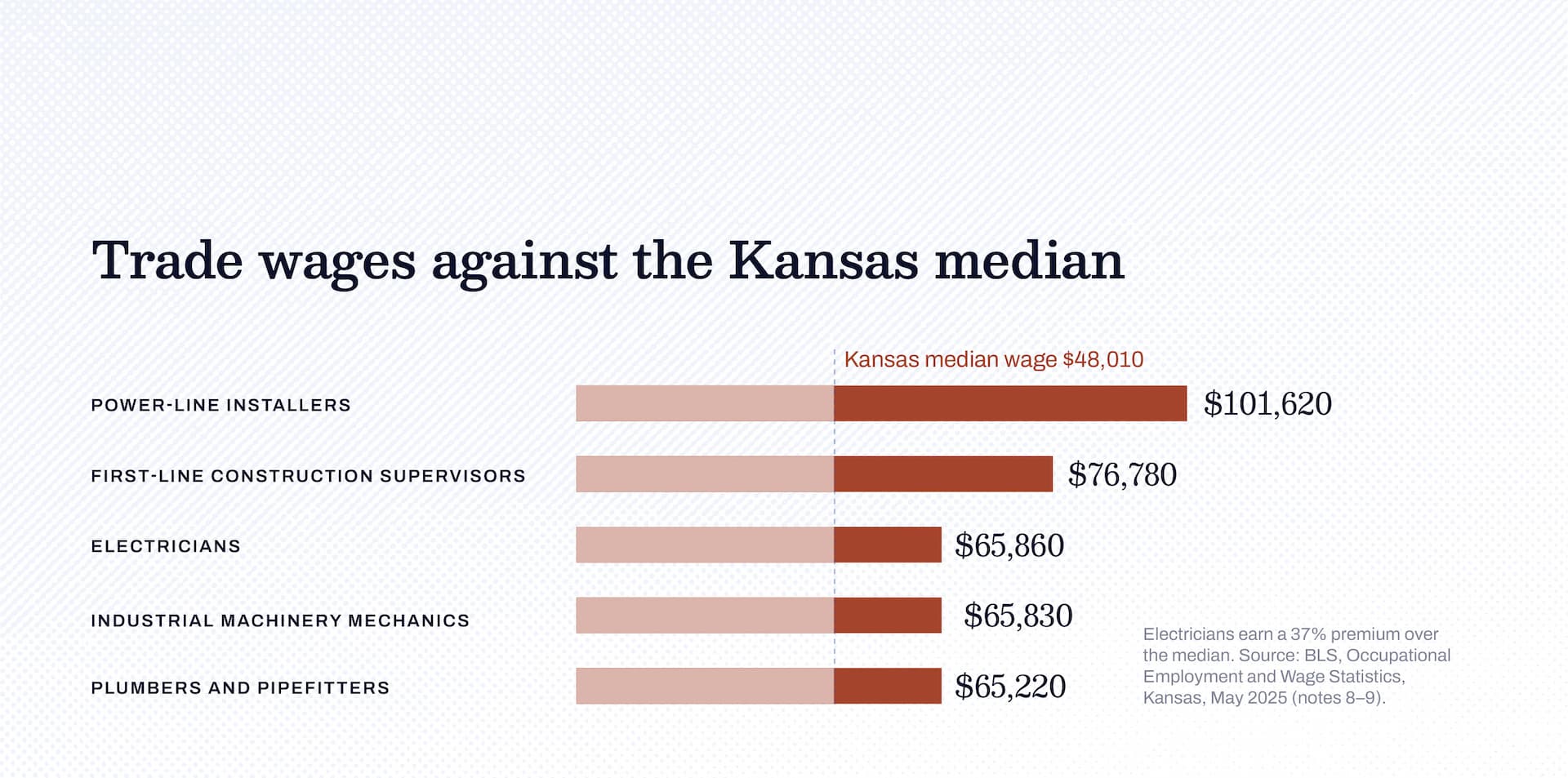
On the labor question, Kansas has a promising pool of talent and has a pathway to growing that pool further. The median Kansas wage is $48,010.8 Electricians earn $65,860, a 37% premium over that median. Plumbers and pipe fitters earn $65,220, and industrial machinery mechanics earn $65,830. First-line construction supervisors make $76,780, and power-line installers reach $101,620. Kansas currently employs 6,350 electricians, 4,590 plumbers, and 7,700 industrial machinery mechanics, against a total workforce of 1,437,520.9 This core workforce is an important building block for new industrial projects. Moreover, the wage level and incoming demand are strong signals to the local economy to bring more applicants into the skilled worker pipeline.
6,350
Electricians employed
BLS, Occupational Employment and Wage
Statistics, Kansas, May 2025, notes 8–9
4,590
Plumbers employed
BLS, Occupational Employment and Wage
Statistics, Kansas, May 2025, notes 8–9
7,700
Industrial Machinery Mechanics employed
BLS, Occupational Employment and Wage
Statistics, Kansas, May 2025, notes 8–9
1,437,520
Total workforce
BLS, Occupational Employment and Wage
Statistics, Kansas, May 2025, notes 8–9
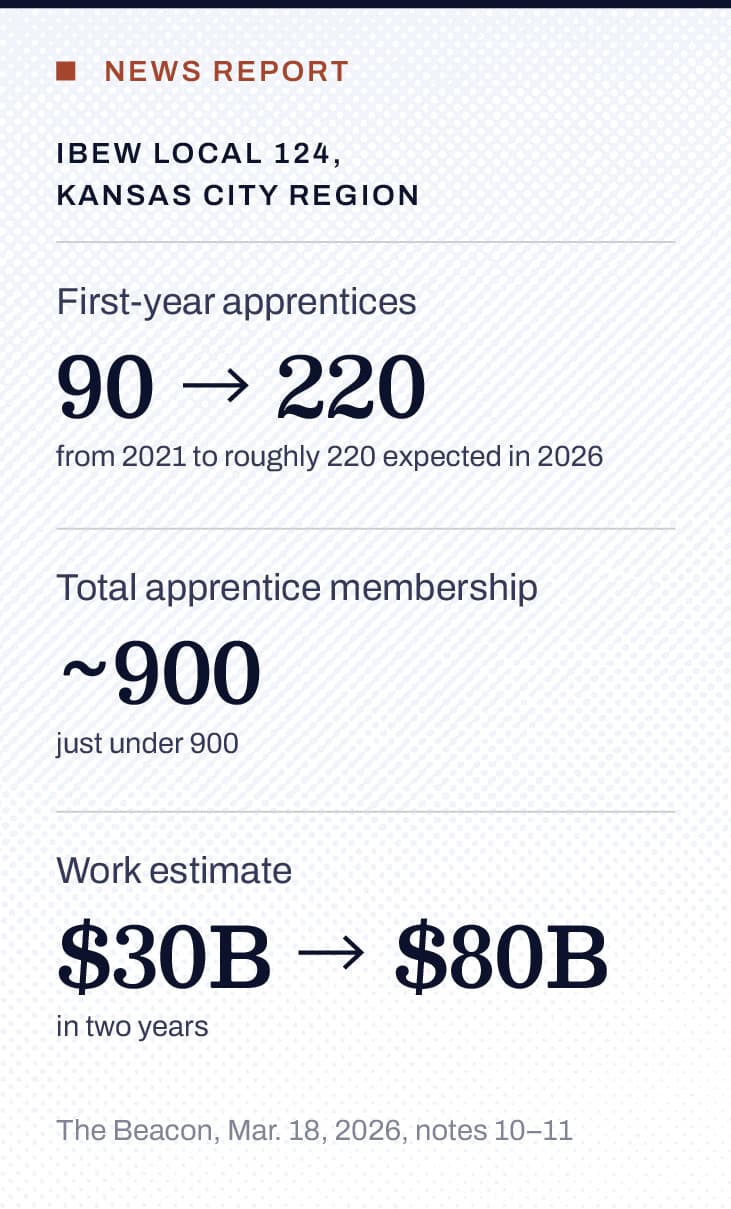
To this end, the apprenticeship programs are already responding. In the Kansas City region, IBEW Local 124, has grown its first-year apprentices from 90 in 2021 to roughly 220 expected in 2026, with total apprentice membership just under 900.10 Its work estimate rose from $30 billion to $80 billion in two years.11 And Laborers Local 264 reported increased demand for its members at data center job sites.12 Between the 2024 and 2025 statewide reports, registered apprenticeships grew to 5,301 residents and 704 employers across 208 recognized occupations.13 The state has already made significant investments to build on this foundation. The Kansas Office of Apprenticeship was created in September 2022, and the for-profit employer credit increased to up to $2,750 after December 31, 2025.14
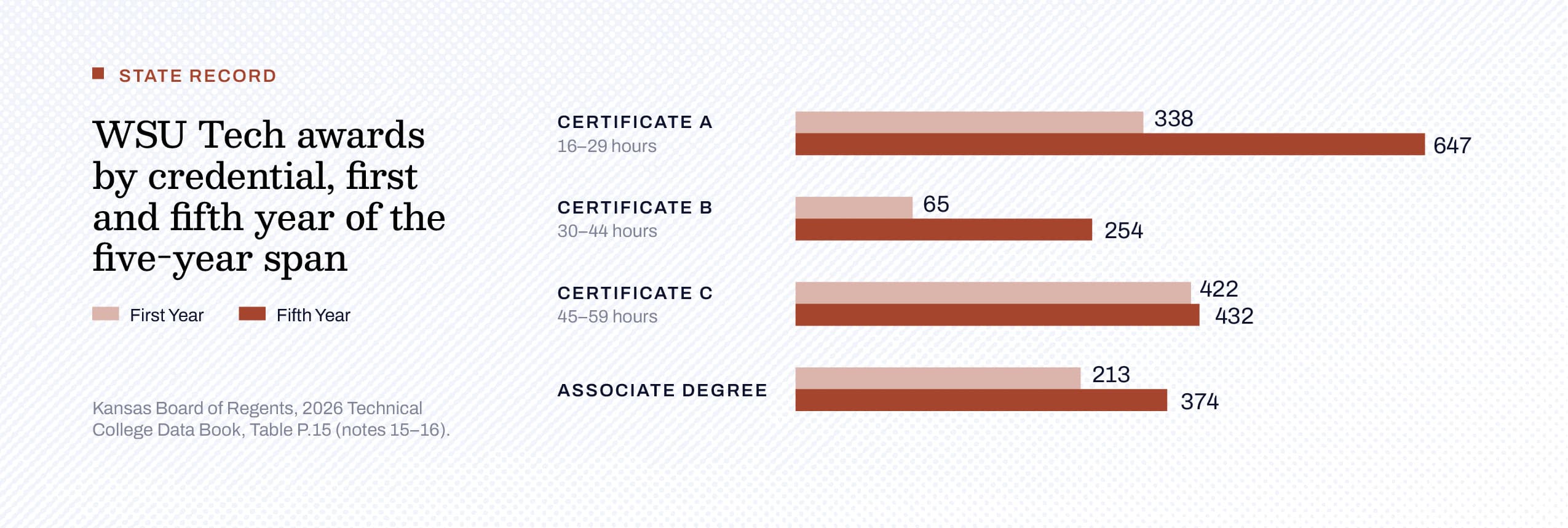
The even better news on this front is that valuable technical skills necessary for supporting this industrial revolution can be acquired through relatively short credentialing programs. For example, WSU Tech shows a striking pattern across five years of awards. The shortest credential, the 16- to 29-hour Certificate A, grew from 338 to 647 awards. The 30- to 44-hour Certificate B grew from 65 to 254. Associate degrees grew from 213 to 374.15 While the 45- to 59-hour Certificate C tier sat nearly flat, moving only from 422 to 432,16 the more intensive associate degree pathway is growing rapidly. That flat middle tier provides some useful indication that students seem to be choosing either the shortest practical certificate or a full associate degree and skipping the awkward step between.
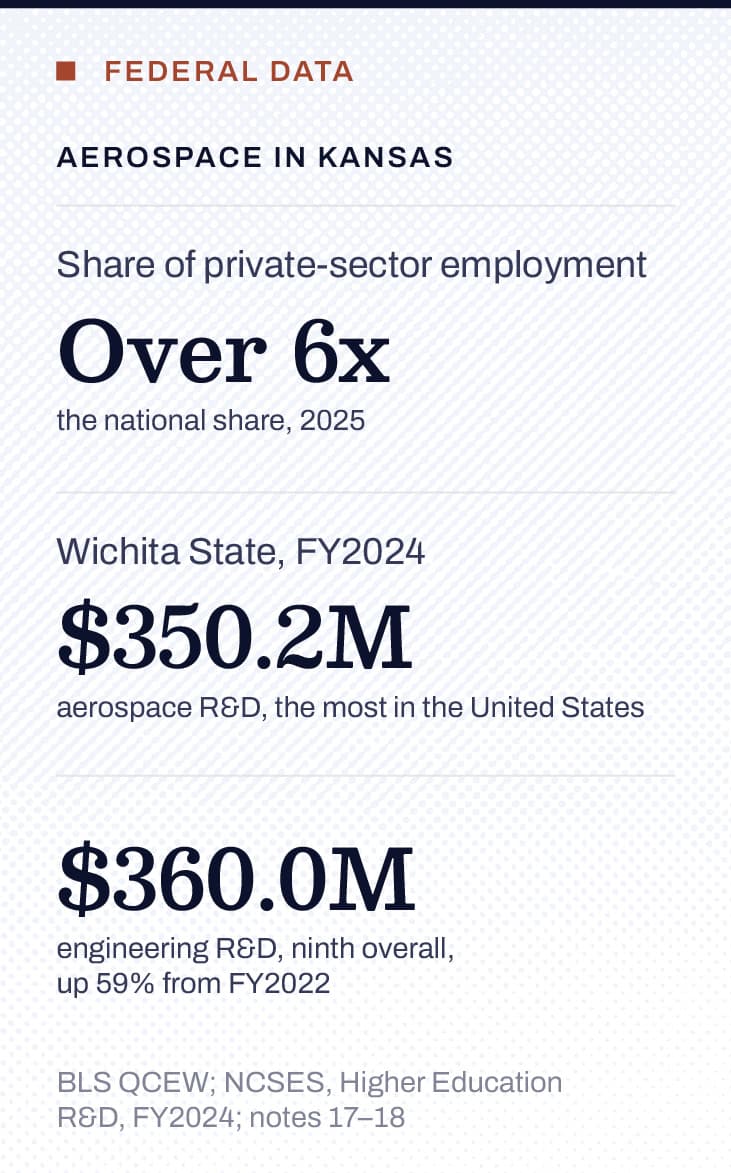
Kansas has already proven that it is highly capable of mobilizing its industrial base in support of technologically advanced industries. The prime example in this regard is aerospace. According to 2025 BLS data, aerospace product and parts manufacturing accounts for a share of Kansas private-sector employment over six times the national share.17 Wichita State reported $350.2 million in aerospace research and development in FY2024, the most in the United States, and ranked ninth overall in engineering research and development at $360.0 million, up 59% from FY2022.18 The National Institute for Aviation Research disassembles and scans retired B-1Bs into high-fidelity 3D models that the Air Force uses to evaluate repairs and structural changes before any work touches an operational airframe.19 Thus, Kansas industry has demonstrated an ability to stand up and support precision manufacturing married to applied research, performed to exacting, certified standards.
And, looking forward, the future of AI-enabled industry will complement licensed work, making it more efficient and increasing demand for it. For instance, a Textron Aviation system can search 60,000 pages of maintenance manuals and, in some cases, cut troubleshooting from 20 minutes down to one or two minutes.20 The technician in question still makes the repair, but the machine-powered search shortens the time necessary to complete the repair significantly. When augmented by AI, the technician’s skill becomes more valuable when the routine lookup is instant, because the hard judgment is left to a person who is paid to own the responsibility.Kansas has also indicated that its industry can shift as demand changes. For example, after softer vehicle demand left slack capacity at Panasonic’s De Soto EV-battery plant, employing about 1,800 workers as of June 2026, the company announced plans to convert part of the plant to data-center battery production.21 That kind of flexibility is the same quality an AI build needs as the Kansas industry learns how to adapt to and incorporate AI.
60,000
Pages of maintenance manuals searched
Microsoft customer story, Mar. 20, 2025, note 20
20 min
Troubleshooting time before
Microsoft customer story, Mar. 20, 2025, note 20
1–2 min
Troubleshooting time after, in some cases
Microsoft customer story, Mar. 20, 2025, note 20
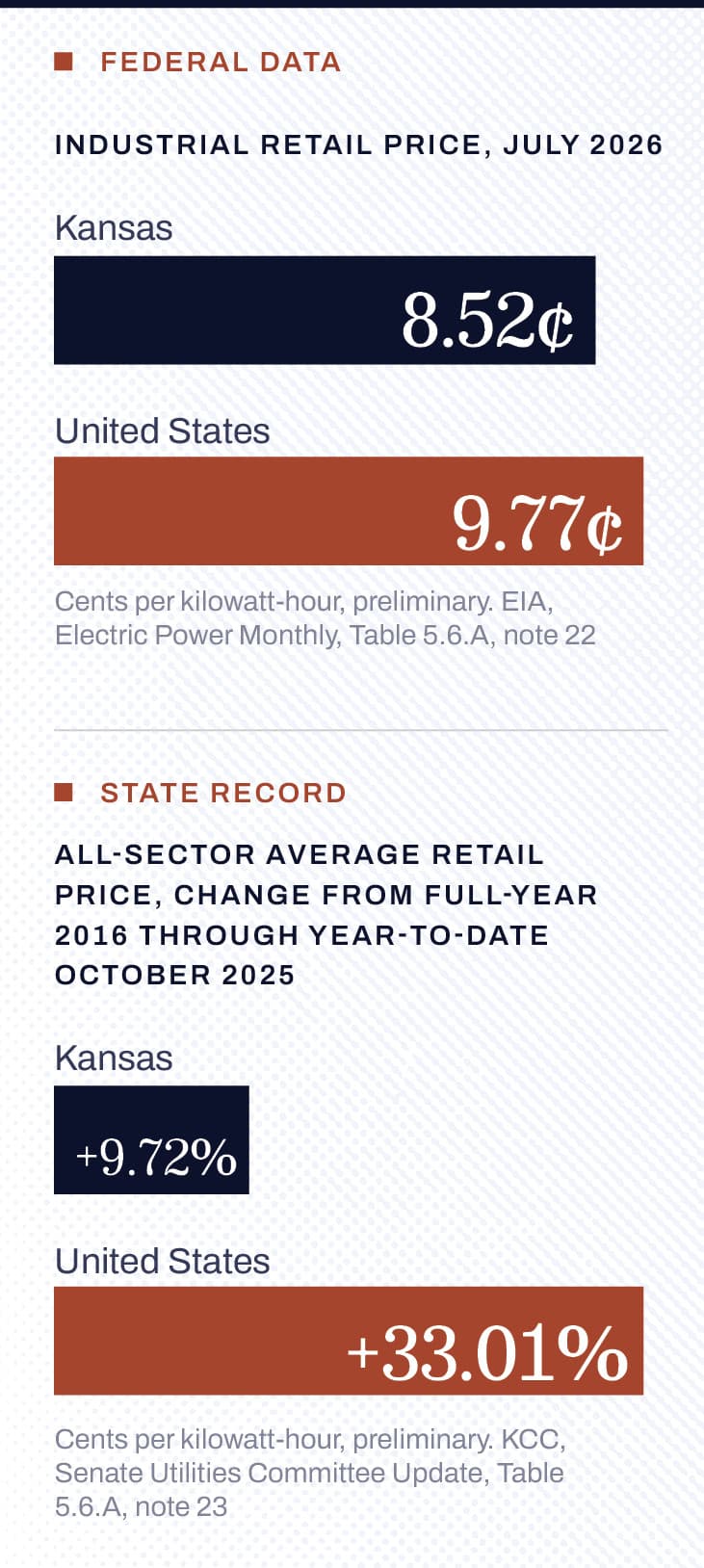
Another major advantage for Kansas in the new industrial revolution is its supply of cheap, stable power. Kansas’s preliminary average industrial retail price was 8.52 cents per kilowatt-hour in July 2026, against 9.77 cents nationally.22 The relative stability of Kansas’s energy pricing is perhaps an even larger asset than the bottom-line price. Kansas’s all-sector average retail price rose 9.72% from full-year 2016 through year-to-date October 2025, while the national figure rose 33.01%.23 For a contract lasting as long as 17 years, stability matters more than a one-month price comparison. A developer who can price power a decade and a half out, and trust that price, is a developer who can build.
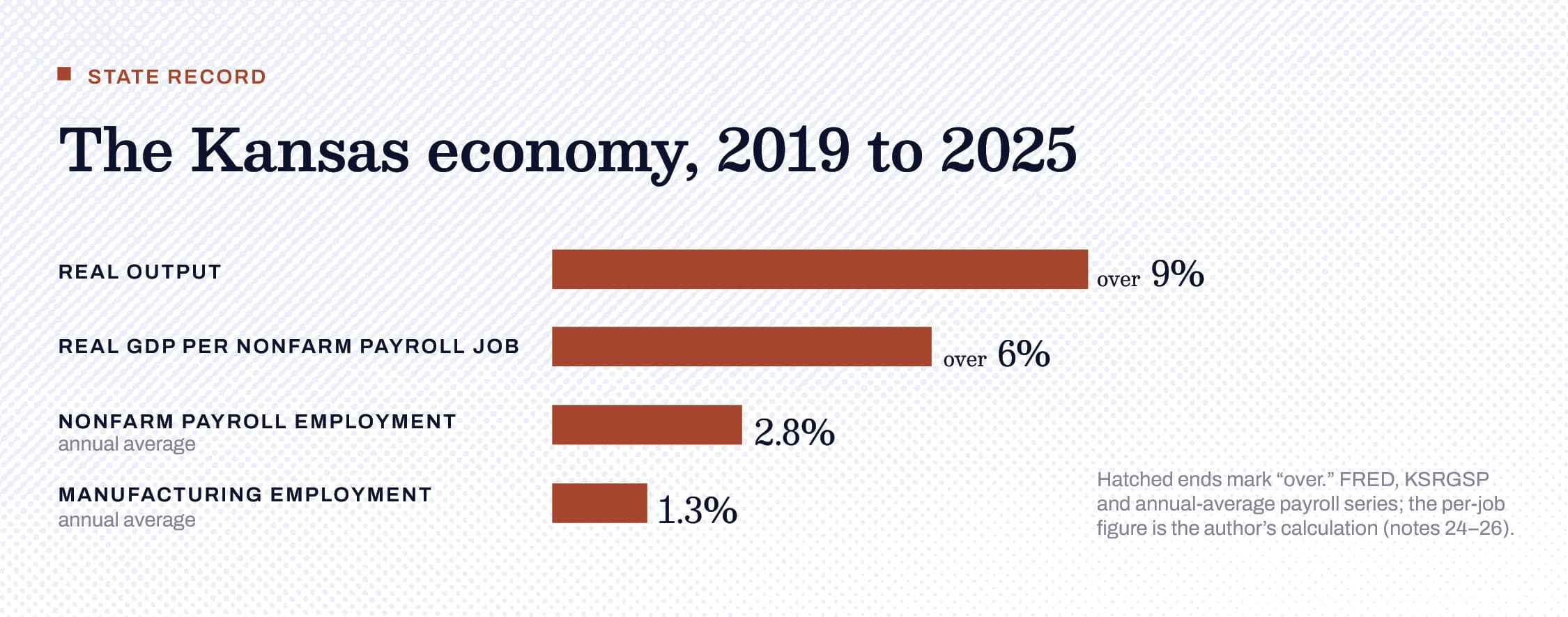
And all of this energy affordability and stability is operating against an incredibly dynamic underlying economy. Kansas real output grew over 9% from 2019 to 2025.24 Over the same years, annual-average nonfarm payroll employment grew 2.8%, and manufacturing employment grew 1.3%.25 Real GDP per nonfarm payroll job rose over 6%.26 Thus, the state’s economy is growing, its manufacturing base is holding strong, and real output per payroll job has risen. The underlying system works and has ample room to absorb a new industrial boom.
In short, Kansas’s industrial and economic capacity argues for a yes to the present moment.
The trades pay well enough to attract people, the apprenticeship engine is scaling in advance of the build, the technical colleges are concentrating their output in the shortest and deepest credentials, aerospace shows the state already builds to certified standards, applied AI amplifies licensed workers, industry can pivot with demand, power is cheap and stable, and output keeps growing. The major constraint on making Kansas the next industrial hub of the United States is regulatory permission.
Why yes is hard
Section IV
The Permission Problem
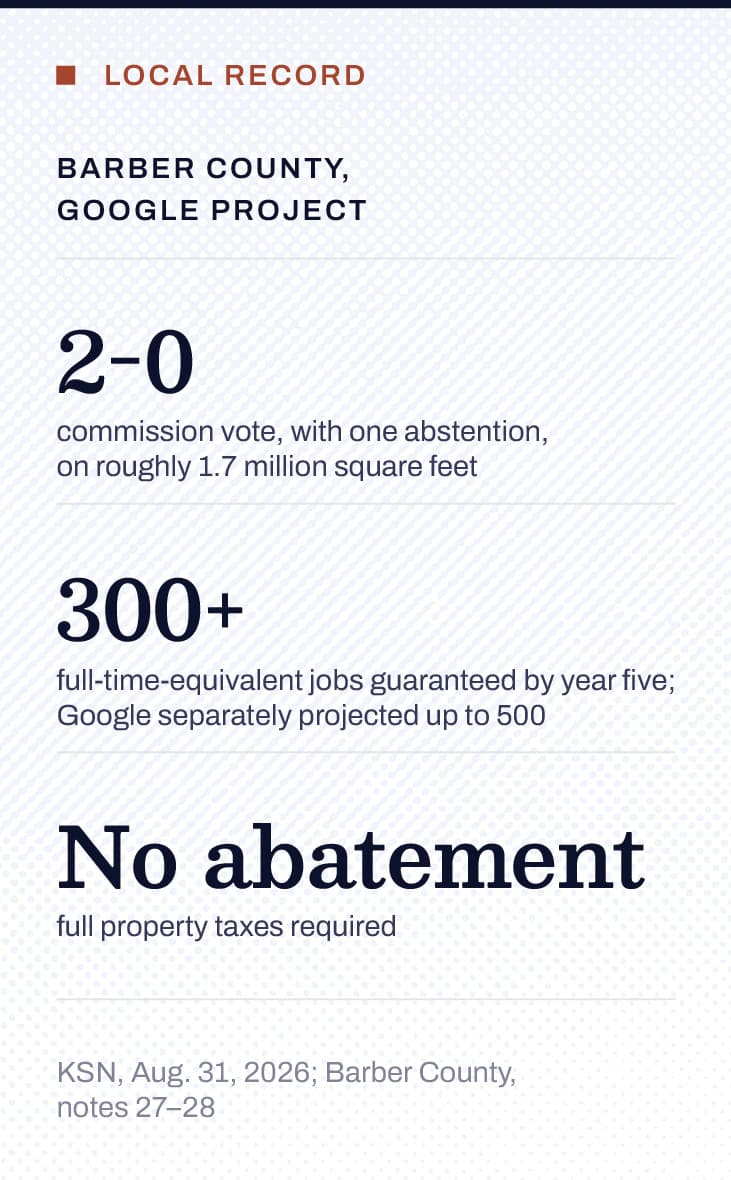
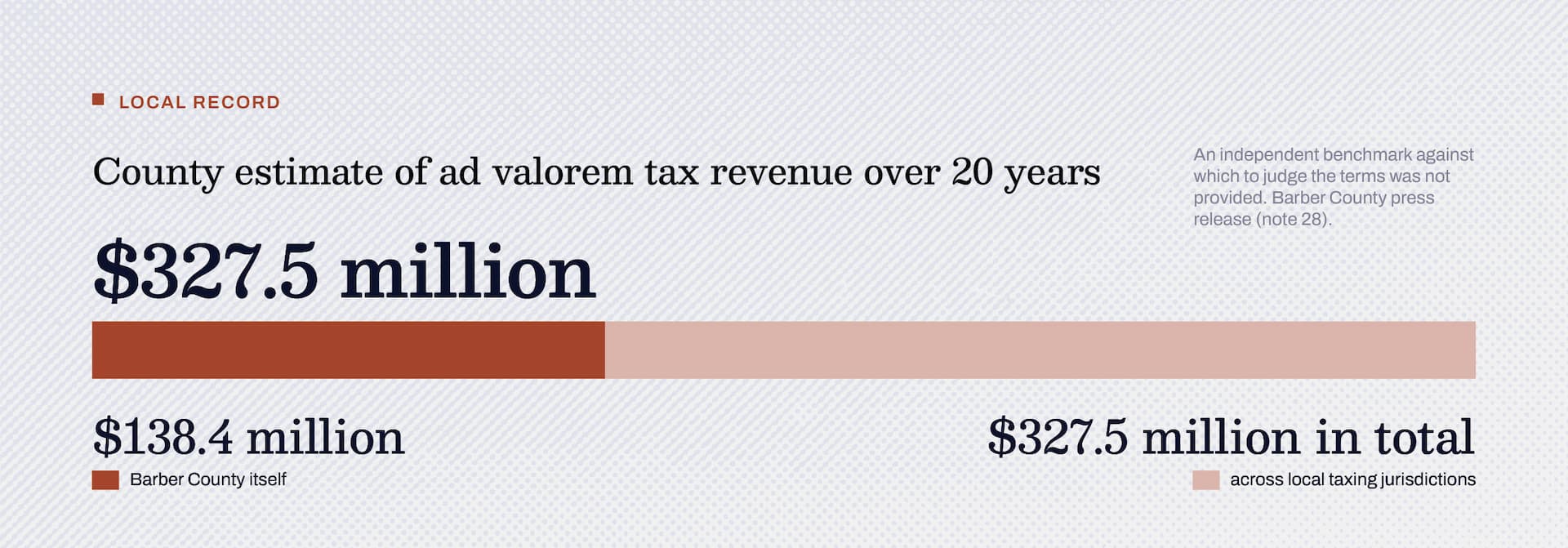
Determining whether the terms of a proposed data center project are fair or desirable and whether a project should move forward is currently a challenging endeavor for county commissions and other governmental bodies. All of the information necessary to make this decision originates with the developer, including the size of the project, the water it will draw, and the jobs it claims it will create. A controversial hearing in Barber County required extra security as residents watched their commission approve a Google project of roughly 1.7 million square feet by a vote of 2 to 0, with one abstention.27 The final agreement required full property taxes with no abatement and guaranteed at least 300 full-time-equivalent jobs by year five. Google separately projected up to 500 jobs. The county's own estimate put ad valorem tax revenue at $327.5 million over 20 years across local taxing jurisdictions, including $138.4 million for Barber County itself.28 Although the terms of that deal reflect careful negotiations, an independent benchmark against which to judge them was not provided.
This is the underlying reality that creates the permission problem. A missing baseline of public information leaves public bodies largely in the dark when trying to determine whether a given project represents a good bargain for a county.
Over the course of 18 months, a number of such deals demonstrate the fragmentation problem across Kansas. The same class of facility produced radically different answers. Lawrence adopted a two-year moratorium with a public-hearing exception process while it considered development-code changes.29 Sedgwick County placed an interim control period for data centers and extended it on Sept. 2, 2026, through Dec. 24, 2026.30 The city of Wichita has no zoning definition for a data center at all, so every proposal gets case-by-case review.31 Edgerton's planning commission denied a project, but the city council later approved it on appeal.32 Developers withdrew from Gardner and Spring Hill.33 De Soto approved two campuses, and Barber County added a third.34 Both the procedures and the necessary disclosures differed across the various forums. This situation creates a great deal of uncertainty for both taxpayers and firms seeking to invest in new facilities.
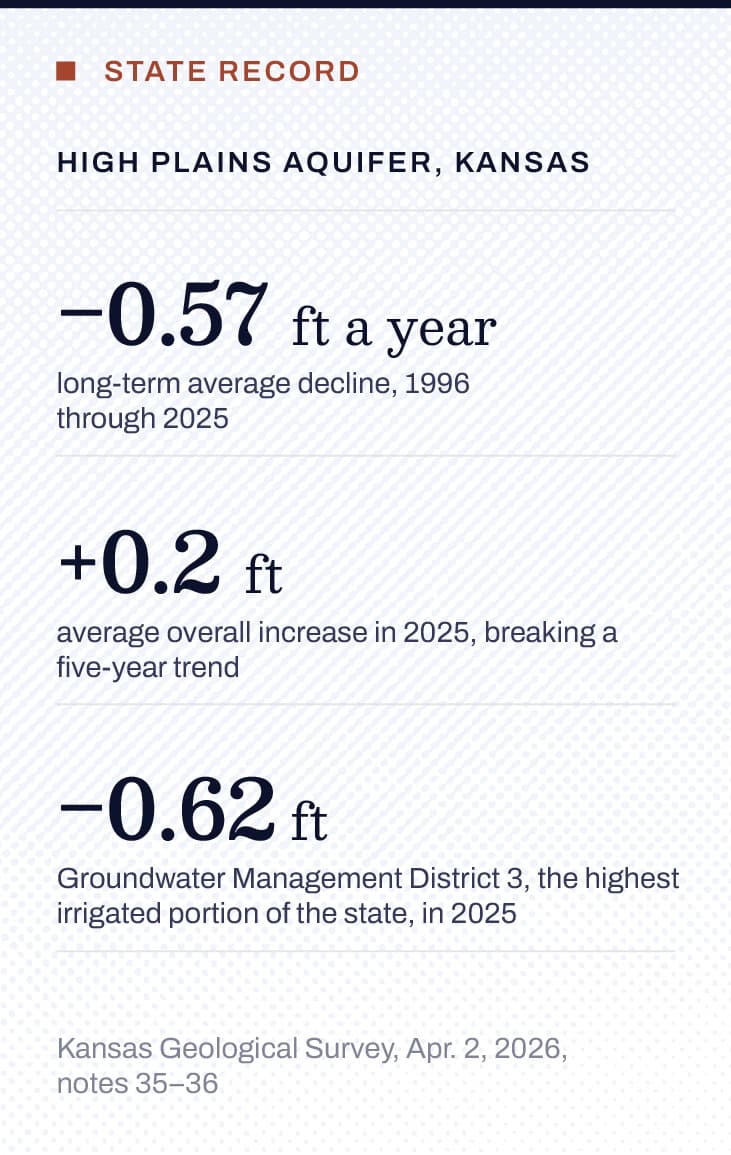
The core problem that needs to be solved is how to help public bodies know what they don’t know in order for them to pose necessary questions. For example, Kansas's High Plains aquifer had a long-term average decline of 0.57 feet per year from 1996 through 2025.35 The aquifer saw an average overall increase of 0.2 feet in 2025, breaking a five-year trend. However, the most heavily irrigated portion of the state, Groundwater Management District 3 still lost 0.62 feet.36 A data center that plans to pull and consume water is making a claim against a resource that is under pressure, at the same time that Kansas does not require every data center to publish project-level withdrawal and consumption figures. A data center holding its own water right must report annual use, while a facility served by a public water supplier may appear only within the supplier’s water-right records.37 Thus, critical questions about something as important as water use may not be answered in the same place, or even in a way that is immediately apparent to an adjudicating body.
Local authority is a critical part of the Kansas political landscape, but it must be well-informed in order to properly function. Land-use decisions most obviously belong at the county and city level, where officials answer to the people who live with the consequences. But not every locality has the same capability. For example, Lawrence had the staff to pause development and begin rewriting its code, which is a luxury of scale.38 Smaller jurisdictions may be able to pause, but undertaking a new rule-making process is far more challenging given the necessary staff and associated costs. However, a small county could make do with more limited resources if it had access to standardized information.
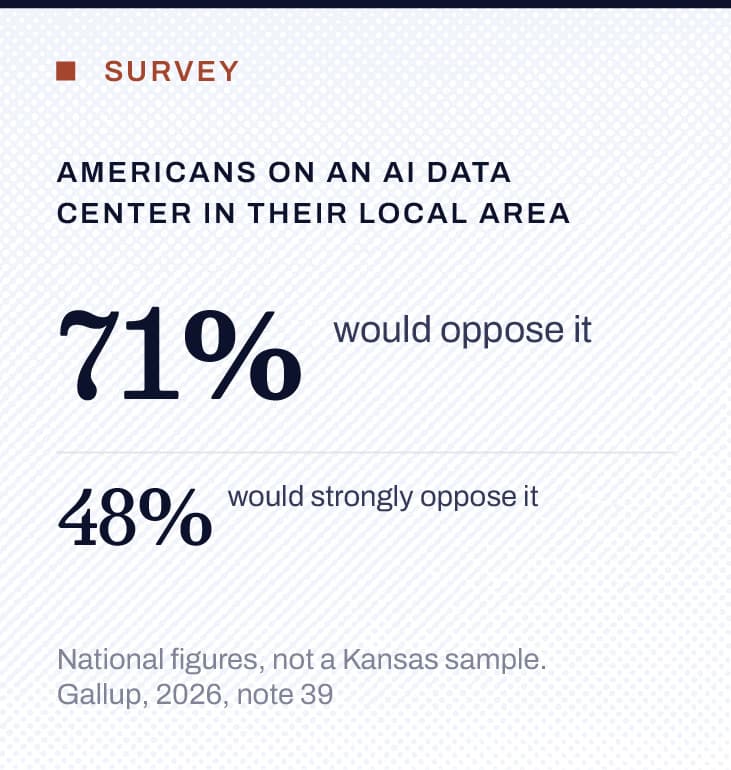
This information gap is a critical issue given the conflicting feelings about data centers among the general public. Gallup found that 71% of Americans would oppose an AI data center in their local area, including 48% who would strongly oppose it.39 Those are national figures, not a Kansas sample, but they describe the sentiment commissioners face. And the disagreement runs through both parties. Governor Kelly defends local authority against a statewide moratorium, while Senator Marshall supports moratoria and questions the tax breaks.40 The main issue with these two positions is that neither is actually proposing what is needed to answer public anxiety and help commissioners do their job: a common review standard.
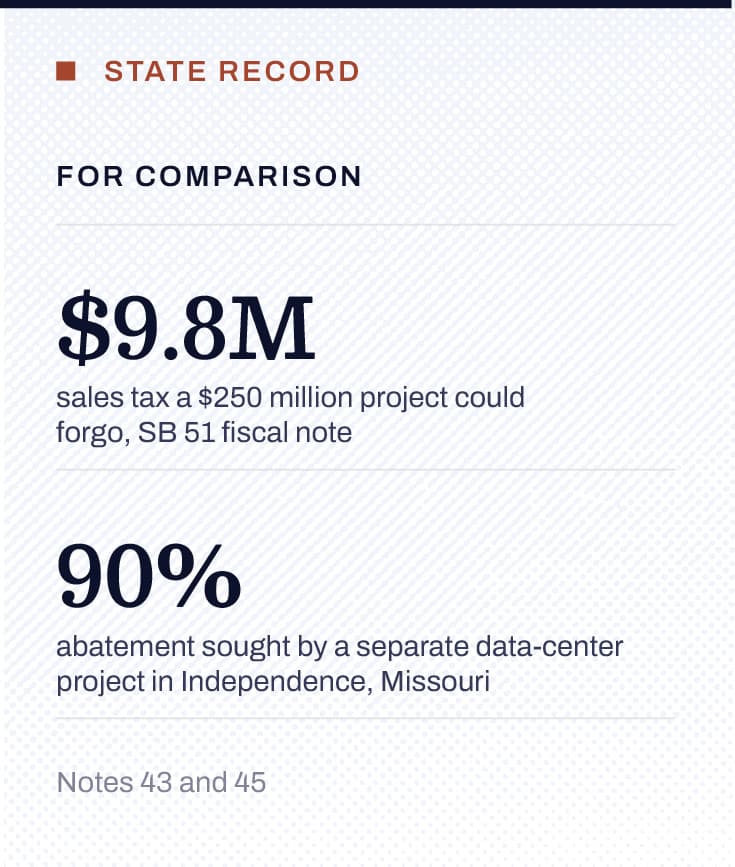
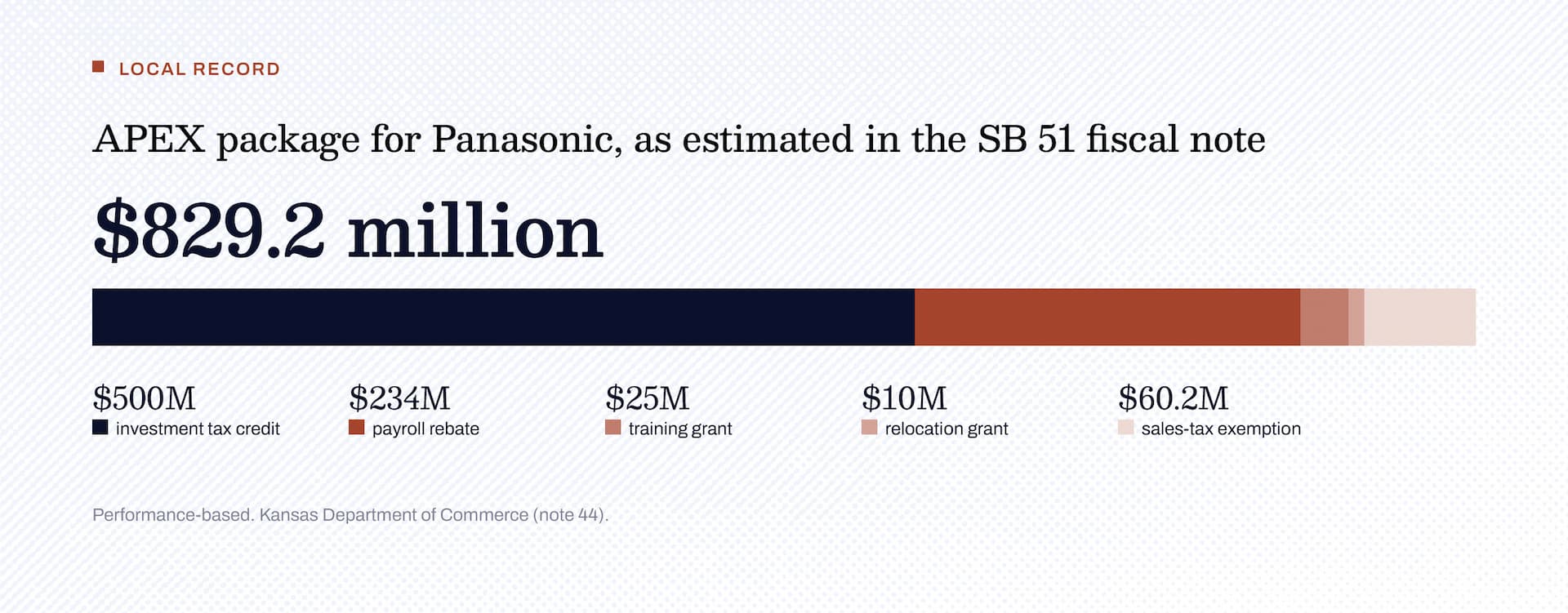
The state incentive, unfortunately, runs in the other direction. While localities struggle to evaluate a single project, the state works to shorten the list of questions anyone can ask. Kansas SB 98 creates a 20-year sales-tax exemption at a $250 million investment threshold met within five years.41 It requires at least 20 new Kansas-resident jobs within two years and sets no wage floor. Once the $250 million minimum is met, further investment does not lengthen the 20-year term.42 The fiscal note for Kansas SB 51 estimated that a $250 million project could forgo $9.8 million in sales tax.43 The same statement estimated Kansas's performance-based APEX package for Panasonic at $829.2 million, including a $500 million investment tax credit, a $234 million payroll rebate, a $25 million training grant, a $10 million relocation grant, and a $60.2 million sales-tax exemption.44 Across the border in Independence, Missouri, a separate data-center project sought a 90% abatement.45 The incentive structure in how these policies are being framed races toward the largest project, while local moratoria brake for the smallest question. This is fundamentally a regulatory mismatch between state and local decisions and needs, with implications for the national infrastructure market.
20
Years of sales-tax exemption; further investment doesn’t lengthen the term
$250M
Investment threshold, met within five years
K.S.A. 74-50,332, note 42Kansas Department of Commerce, note 41
20
New Kansas-resident jobs required within two years
K.S.A. 74-50,332, note 42
None
Wage floor required
K.S.A. 74-50,332, note 42
The permitting mismatch also affects the Kansas firms that would compete to build these projects. Local electrical, mechanical, concrete, and excavation contractors are usually bidders or subcontractors rather than the applicants seeking land-use approval, but a delayed or abandoned project can still cost them time. Estimating, workforce planning, licensing, and equipment planning may begin before the work is awarded. If a moratorium or an extended approval process postpones the project, that preparation may produce no revenue. Larger contractors can spread that risk across more projects and markets. A small contractor with only a few active bids has less room to absorb it. This leads to a perverse situation where the firms best able to build the future of Kansas are the ones least able to bear the cost of navigating its permitting process.
None of this necessarily reflects ill intent or malfeasance. A commissioner deciding without a common measure is not acting in bad faith, any more than a resident objecting without full information is acting in ignorance. Both are acting on what they can see, and neither can see enough. Thus, what is critical for Kansas to answer now is, in terms of public policy, how do we get the public and local officials to a well-informed “yes” on data center projects.
What a good yes looks like
Section V
Federal Floor and Policy
Who knows what?
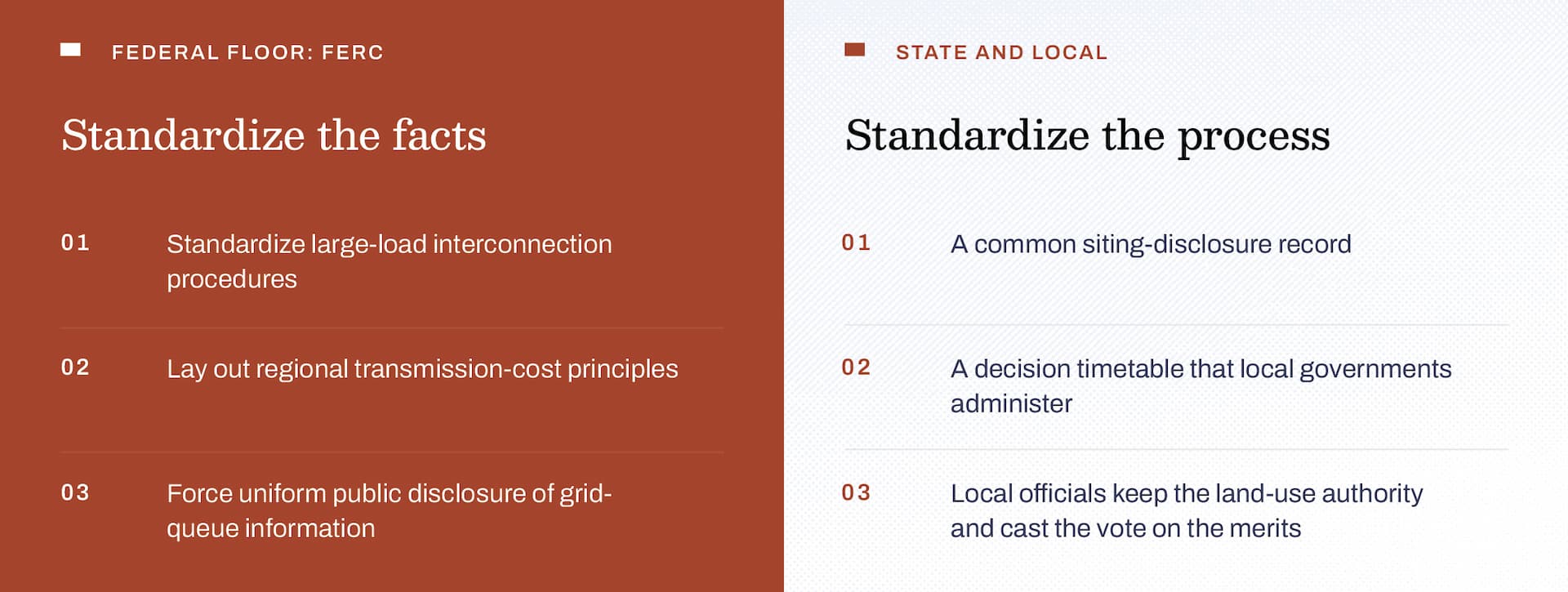
In terms of power, the solution has two broad components: one federal, and the other state and local. On the federal side, facilitating reasonable expectations about access to power is critical. FERC regulates interstate transmission service and wholesale power markets, and it should set the rules that govern how a large load enters those systems. A federal floor should standardize large-load interconnection procedures, lay out regional transmission-cost principles, and force uniform public disclosure of grid-queue information. On the state and local side, siting decisions require a common siting-disclosure record and a decision timetable that local governments administer. Local officials should keep the land-use authority and cast the vote on the merits. This division creates a clean approach to understanding the power dimension of a data center project. Washington standardizes the set of facts that every state can rely upon, while the state standardizes the processes for relying on that information.
The state needs to go further in creating guidance for localities that consider applications for data centers. Starting at the application stage, an applicant should disclose its expected contractual load, the cooling technology it plans to use, projected water withdrawal and consumption, construction and permanent employment broken down by trade, the local tax payments it expects to make, and its interconnection schedule. In short, an applicant needs to be able to answer straightforward questions any given locality would have when faced with the choice of permitting a data center: what does this project take from us, and what does it return?
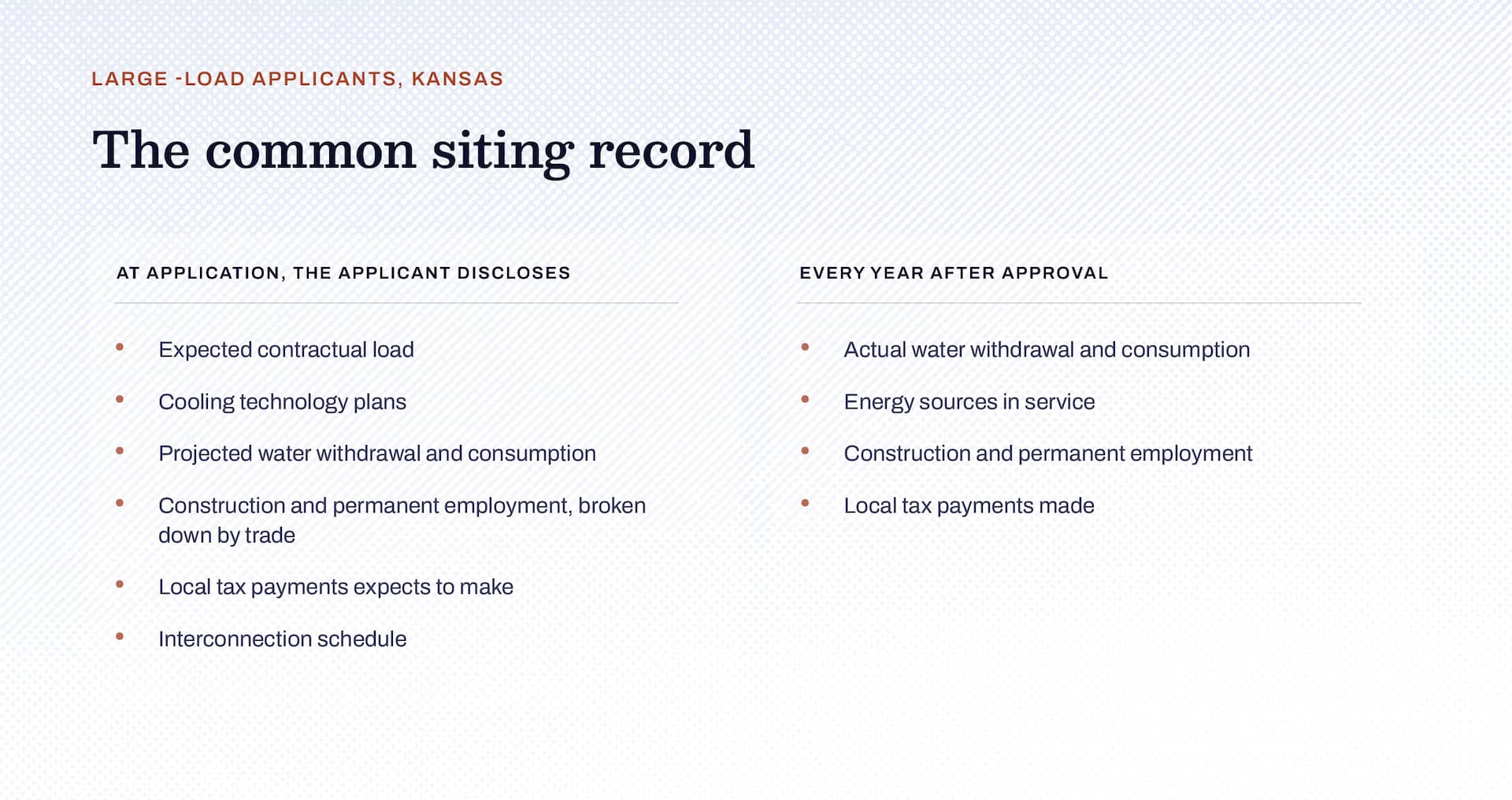
Approval, moreover, should not represent the end of necessary disclosure. These important projects should have annual reporting requirements that help a community understand how the project developed and whether it’s operating as promised. This includes requirements to disclose actual water withdrawal and consumption, the energy sources in service, construction and permanent employment, and the local tax payments paid. Requiring this level of ongoing oversight that helps monitor any gap between the application estimate and the operating reality provides a crucial level of reassurance to local communities.
Who Pays?
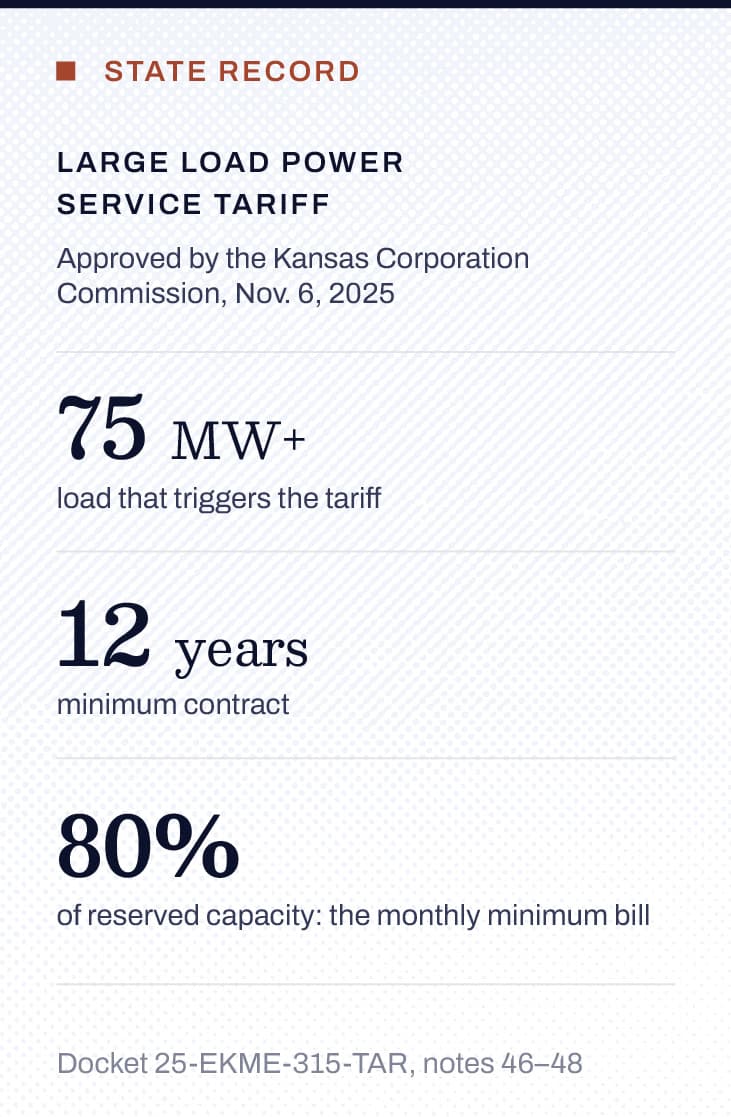
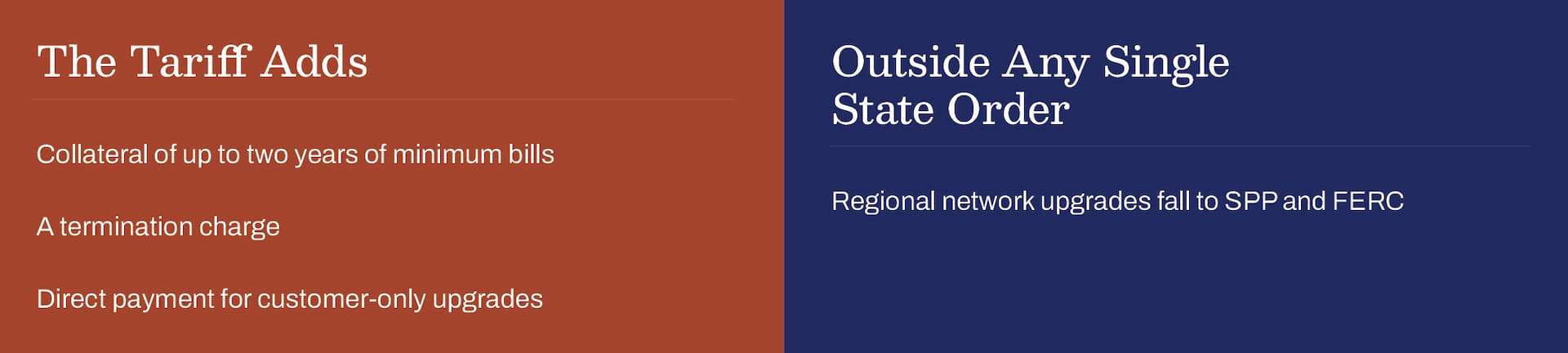
Cost assignment for the energy needs of data centers already has a working model inside Kansas. Under the Large Load Power Service tariff, the Kansas Corporation Commission mandated on November 6, 2025, that a load of 75 megawatts or more triggers a minimum 12-year contract and a monthly minimum bill calculated at 80% of reserved capacity. The tariff adds collateral of up to two years of minimum bills, a termination charge, and direct payment for customer-only upgrades.46 The design intent is explicitly aimed at making sure that existing customers do not subsidize the new load.47 There is a limitation to the tariff, however, insofar as regional network upgrades fall to SPP and FERC. This means that no single state order can settle the full allocation question.48
Beyond the Large Load Power Service tariff, the background settled law demands that the beneficiary pays.49 A federal large-load rule should therefore identify the measurable beneficiaries before regional costs enter the queue. By first identifying the beneficiaries, the beneficiary tracking guarantees equitable payments, instead of letting the largest load bargain its way to the cheapest connection at someone else’s expense.50
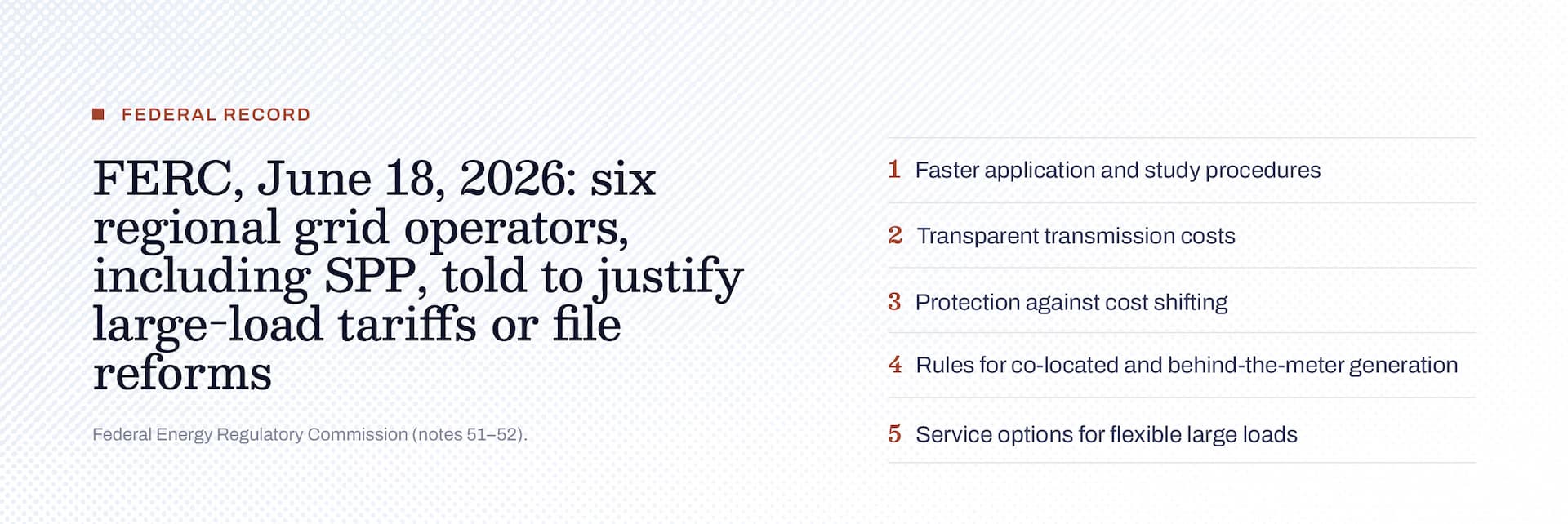
Federal action on this question is already underway. On June 18, 2026, FERC ordered six regional grid operators, including SPP, to justify their large-load tariffs or file reforms.51 The commission identified faster application and study procedures, transparent transmission costs, protection against cost shifting, rules for co-located and behind-the-meter generation, and service options for flexible large loads.52 This floor would enable communities to understand what is being asked of them, and Kansas should support this docket as a chance to lock in rules its own communities need.
How do we turn the lights on and keep them on?
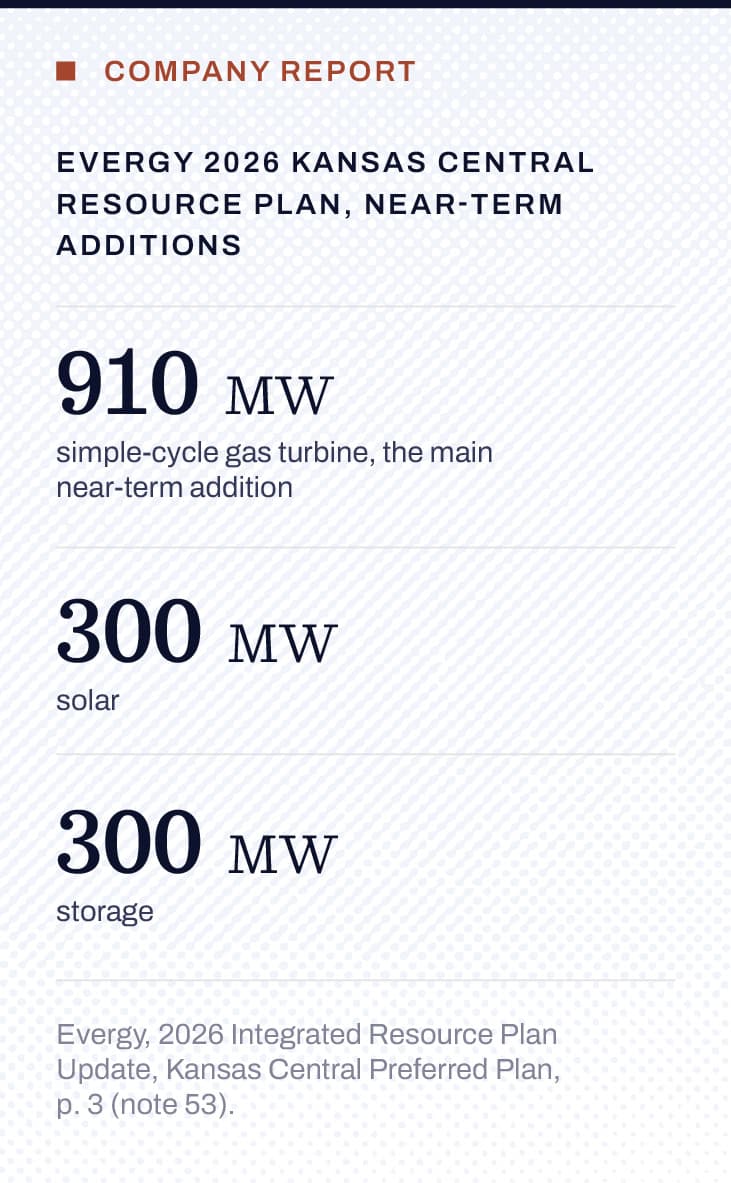
Cost assignment does not settle the generation question. Evergy’s 2026 Kansas Central resource plan identifies a 910-megawatt simple-cycle gas turbine as its main near-term addition, alongside 300 megawatts of solar and 300 megawatts of storage.53 The plan outlines intentions but also demonstrates why ongoing disclosure requirements would be useful. A community cannot evaluate what it is buying if the generation behind its new data center is opaque until the turbines spin.
The public return should also be measurable. SB 98 grants qualifying data centers a 20-year sales-tax exemption if they invest at least $250 million and create 20 Kansas jobs, but it establishes no wage standard and provides limited public information about operating results.54 Kansas should require annual disclosure of capital investment, construction and permanent employment, wages, state and local tax payments, electricity demand, and water use. Lawmakers should condition eligibility for state incentives, in part, on verified workforce commitments, including participation in registered-apprenticeship programs, prevailing wages during construction, and public reporting of local hiring results. Kansas has used performance-based incentives for other large projects, including Panasonic.55
Who will help make this happen?
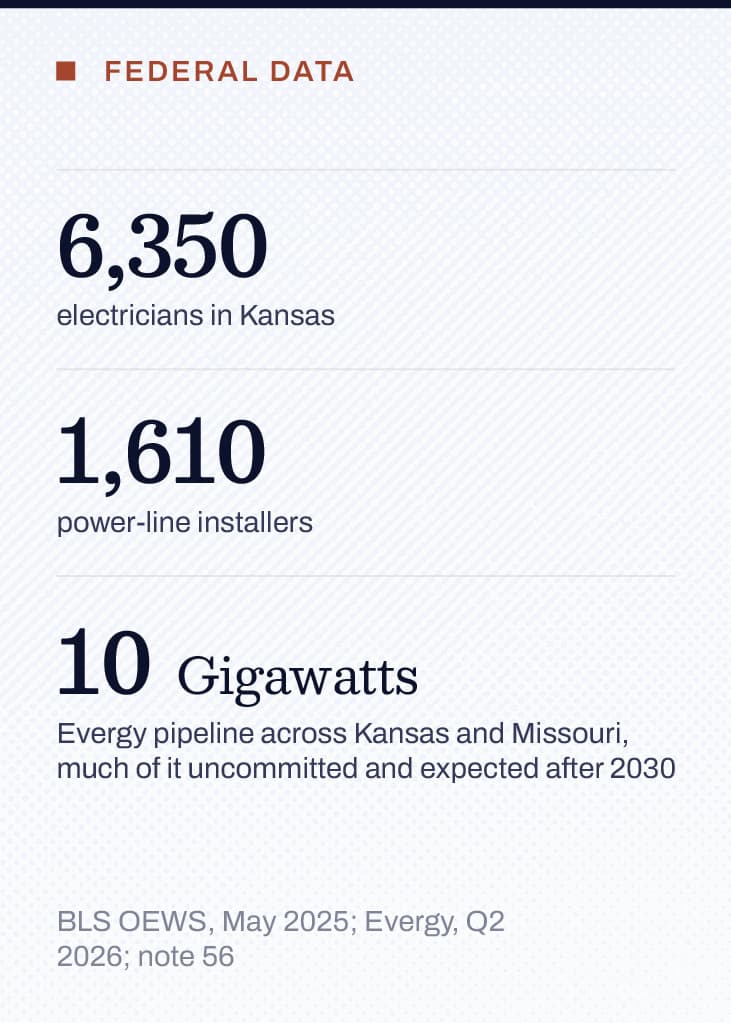
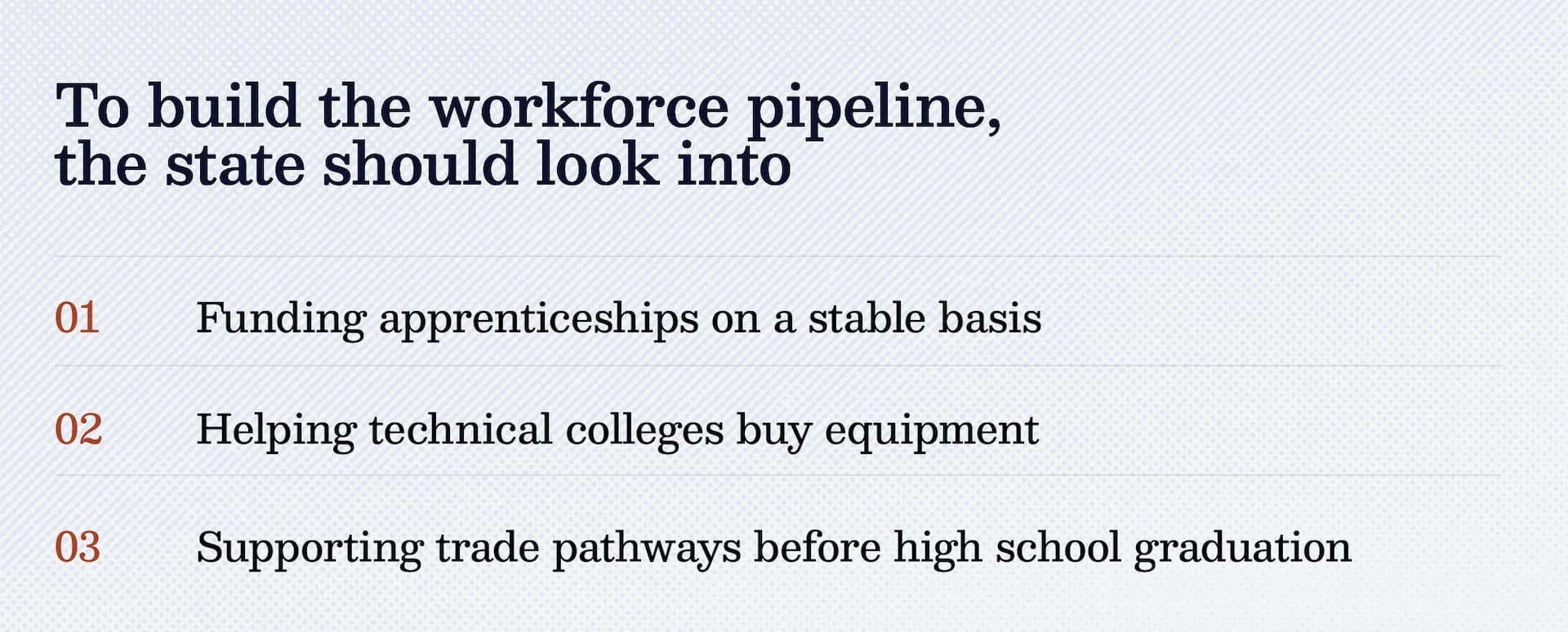
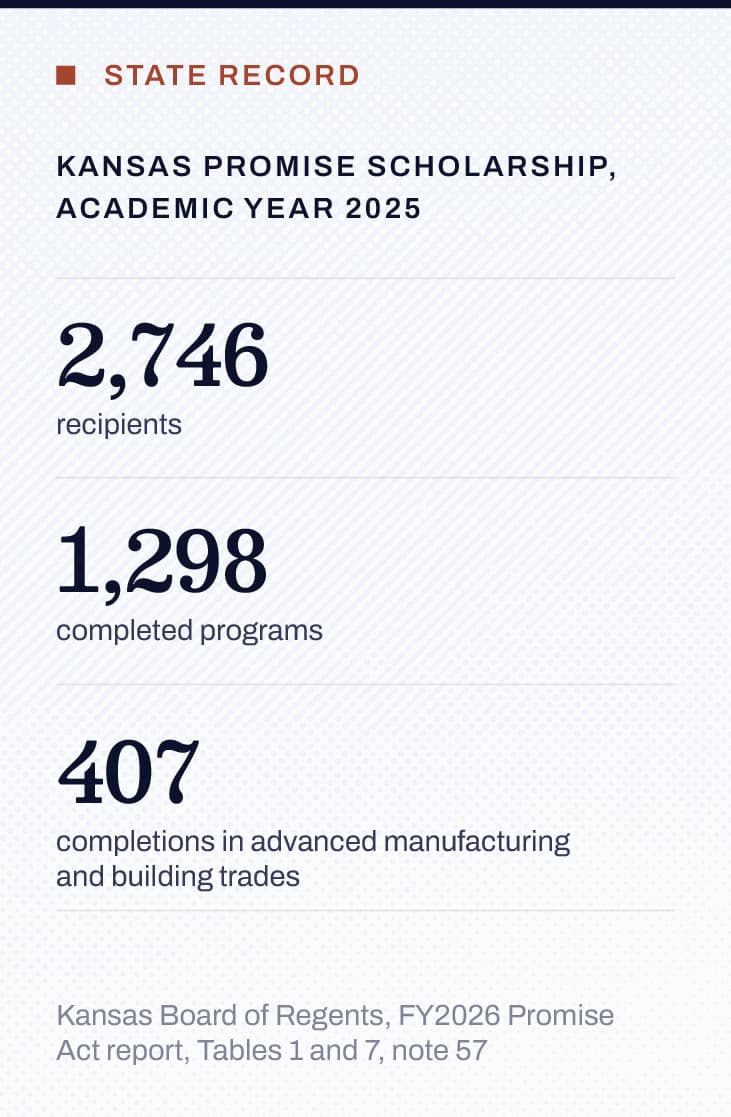
The trades will need to be treated as a critical component of these projects. Kansas employs 6,350 electricians and 1,610 power-line installers, while Evergy reports a pipeline above 10 gigawatts across its Kansas and Missouri territory, much of it uncommitted and expected after 2030.56 Workforce capacity is, therefore, an important planning issue. To build the necessary workforce pipeline, the state should look into funding apprenticeships on a stable basis, helping technical colleges buy equipment, and supporting trade pathways before high school graduation. A good model for this is the Kansas Promise Scholarship, which served 2,746 recipients in academic year 2025, and 1,298 completed programs, including 407 completions in advanced manufacturing and building trades.57
Inventive design in state programs should encourage employer-led training. A 2026 study covering programs in 18 states found that training grants were more common where firms faced a greater risk that competitors would hire away their trained workers.58 Participating firms showed sustained employment growth and opened more positions to workers with lower formal skill requirements.59 The study suggested that grants, therefore, can address employers’ reluctance to fund training when poaching is a threat.
Conclusion
Section VI
The question that opened this paper is the permission question: whether a state should let a data center in and on what terms. The answer is an unconditional “yes” when backed up by the supporting public policy and useful information that helps empower local communities to join the new industrial revolution.
Kansas has what it takes to build these systems and to apply them. It has the trades, the colleges, and the proven industrial base. It has applied research and stable, affordable power. The permission problem is not a shortage of capacity but a missing baseline of public information.
The most important recommendation here is to build that baseline. Federal rules should cover large-load interconnection, regional transmission costs, and grid-queue reporting. Kansas should require project-level disclosure of water use, electricity load, jobs, and taxes while preserving local land-use authority. Kansas can build that disclosure floor now, with a published benchmark of typical terms and incentives conditioned on verified local benefit.
Done right, the yes turns an infrastructure build into lasting, local economic growth. Long term, Kansas workers can then sell their skills and business activity to a national market. Done wrong, it leaves Kansas behind.

- Federal Reserve Bank of St. Louis, “All Employees: Construction in Kansas (KSCONS),” Federal Reserve Economic Data, retrieved September 26, 2026. https://fred.stlouisfed.org/graph/fredgraph.csv?id=KSCONS.
- City of Lawrence, meeting minutes, July 14, 2026, https://lawrenceks.civicweb.net/document/470538/; Wichita and Sedgwick County data-center record, https://www.wichita.gov/datacenters; City of Edgerton, DAMAC Data Center record, https://edgertonks.org/damac-data-center/; Barber County, Data Center record, https://barber.ks.gov/data-center.html; Development Agreement, City of De Soto & Mount Sunflower Properties, LLC, dated September 23, 2025 — desotoks.us/DocumentCenter/View/3805/Final-Development-Agreement-De-Soto---Mount-Sunflower.
- Federal Reserve Bank of Kansas City, Manufacturing Survey, AI Special Question, Oct. 23, 2025, https://www.kansascityfed.org/documents/12672/2025Oct23.pdf.
- Id.
- KCUR, “De Soto’s data center project doubled in size from initial designs, drawing complaints,” July 9, 2026, https://www.kcur.org/housing-development-section/2026-07-09/de-soto-data-center-complaints-beale-infrastructure.
- Instead, these requirements are covered across a number of provisions including https://www.kslegislature.gov/b2025_26/laws/012_000_0000_chapter/012_007_0000_article/012_007_0057_section/012_007_0057_k/ ; https://www.kslegislature.gov/b2025_26/laws/074_000_0000_chapter/074_050_0000_article/074_050_0227_section/074_050_0227_k/ ; and https://www.kslegislature.gov/b2025_26/laws/074_000_0000_chapter/074_050_0000_article/074_050_0332_section/074_050_0332_k/
- José María Alvarez, David Argente, S. Serena Chow, and Diana Van Patten, “Data Centers and Local Economies in the Age of AI: A Shift-Share Approach,” NBER Working Paper 35194, May 2026, revised Sept. 2026, https://www.nber.org/papers/w35194.
- U.S. Bureau of Labor Statistics, Occupational Employment and Wage Statistics, Kansas, May 2025, https://data.bls.gov/oes/#/area/2000000/2025.
- Id.
- The Beacon, “Kansas City Data Centers, AI, and Job Security,” Mar. 18, 2026, https://thebeaconnews.org/stories/2026-03-18/kansas-city-data-centers-ai-job-security/.
- Id.
- Id.
- Kansas Department of Commerce, Kansas Apprenticeship Program 2025 Annual Report, https://www.kansascommerce.gov/wp-content/uploads/2026/02/2025-Apprenticeship-report-v5.pdf.
- K.S.A. 74-50,231, https://kslegislature.gov/b2023_24/laws/074_000_0000_chapter/074_050_0000_article/074_050_0231_section/074_050_0231_k/.
- Kansas Board of Regents, 2026 Technical College Data Book, Table P.15, pp. 95–96, https://kansasregents.gov/resources/PDF/Data/Technical_College_Data_Books/Technical_College_Data_Book_2026_FINAL.pdf.
- Id.
- U.S. Bureau of Labor Statistics, Quarterly Census of Employment and Wages, 2025 annual averages, Kansas, private ownership, NAICS 3364, “Aerospace Product and Parts Manufacturing,” location quotient for annual average employment, 6.12, BLS QCEW data, https://data.bls.gov/cew/data/api/2025/a/industry/3364.csv; see also BLS explanation of location quotients, https://www.bls.gov/cew/about-data/location-quotients-explained.htm.
- National Center for Science and Engineering Statistics, Higher Education Research and Development: Fiscal Year 2024, Table 22, https://ncses.nsf.gov/pubs/nsf26304/assets/nsf26304.pdf.
- U.S. Air Force Life Cycle Management Center, “B-1 bomber departs Wichita months ahead of schedule following historic backbone replacement,” May 2026, https://www.aflcmc.af.mil/NEWS/Article/4484118/b-1-bomber-departs-wichita-months-ahead-of-schedule-following-historic-backbone/
- Microsoft, “Textron Aviation transforms troubleshooting with Azure OpenAI Service,” Mar. 20, 2025, https://www.microsoft.com/en/customers/story/23024-textron-aviation-azure-open-ai-service.
- Kansas Reflector, “Panasonic to shift some Kansas production lines to make AI data center batteries,” June 17, 2026, https://kansasreflector.com/2026/06/17/panasonic-to-shift-some-kansas-production-lines-to-make-ai-data-center-batteries/.
- U.S. Energy Information Administration, Electric Power Monthly, Table 5.6.A, July 2026, https://www.eia.gov/electricity/monthly/epm_table_grapher.php?t=epmt_5_6_a.
- Kansas Corporation Commission, Senate Utilities Committee Update, Jan. 15, 2026, https://www.kcc.kansas.gov/images/PDFs/presentations-and-legislative-testimony/2026_Senate%20Utilities%20Committee%20Update_15Jan.pdf.
- Federal Reserve Bank of St. Louis, Real Gross Domestic Product: All Industry Total in Kansas (KSRGSP), https://fred.stlouisfed.org/series/KSRGSP.
- All Employees: Total Nonfarm in Kansas, annual average, https://fred.stlouisfed.org/series/SMU20000000000000001A; All Employees: Manufacturing in Kansas, annual average, https://fred.stlouisfed.org/series/SMU20000003000000001A.
- Author's calculation using U.S. Bureau of Economic Analysis real GDP for Kansas and annual averages of U.S. Bureau of Labor Statistics nonfarm payroll employment. Real GDP per payroll job increased from approximately $119,100 in 2019 to $126,500 in 2025, and Annual-average nonfarm jobs increased from 1,423.83 thousand to 1,463.4 thousand.
- KSN, “Google data center approved in Barber County,” August 31, 2026. https://www.yahoo.com/news/us/articles/google-data-center-approved-barber-165949766.html
- Id.; https://barber.ks.gov/uploads/5/6/1/9/56198487/press_release.pdf.
- City of Lawrence, meeting minutes, July 14, 2026, https://lawrenceks.civicweb.net/document/470538/.
- Wichita and Sedgwick County data-center record, https://www.wichita.gov/datacenters.
- Id.
- City of Edgerton, DAMAC Data Center record, https://edgertonks.org/damac-data-center/; KCUR, “Edgerton approves data center over planning commission’s rejection,” July 25, 2026, https://www.kcur.org/housing-development-section/2026-07-25/edgerton-data-center-city-council-planning-commission.
- Barber County, Data Center record, https://barber.ks.gov/data-center.html.
- City of Gardner, “Beale Infrastructure withdraws proposed data center project application,” https://www.gardnerkansas.gov/news_detail_T17_R72.php ; Taylor O’Connor, “Plans for Spring Hill data center withdrawn,” Kansas City Star, Mar. 6, 2026, https://www.kansascity.com/news/local/community/johnson-county/article314956730.html
- Kansas Geological Survey, “Groundwater levels in the Kansas High Plains aquifer see first overall increase since 2019,” Apr. 2, 2026, https://kgs.ku.edu/news/article/groundwater-levels-in-the-kansas-high-plains-aquifer-see-first-overall-increase-since-2019.
- Id.
- K.S.A. 82a-732(a)–(b) (annual water use report required of “the owner of a water right or permit to appropriate water for beneficial use,” filed with the Chief Engineer of the Division of Water Resources by March 1; failure subject to civil penalty up to $1,000 per water right and indefinite suspension of the right). See also Kan. Admin. Regs. § 5-3-5o (amending water use reports); Kan. Admin. Regs. § 5-14-12 (civil penalties).
- City of Lawrence, meeting minutes, July 14, 2026, https://lawrenceks.civicweb.net/document/470538/.
- Gallup, “Americans Oppose AI Data Centers in Their Local Area,” 2026, https://news.gallup.com/poll/709772/americans-oppose-data-centers-area.aspx.
- Kansas Reflector, Aug. 26, 2026, https://kansasreflector.com/2026/08/26/kansans-fear-impacts-of-data-centers-despite-promise-of-economic-benefits/; coverage of Sen. Roger Marshall’s July 22, 2026, Semafor remarks, https://currently.att.yahoo.com/att/republican-senator-rails-against-ai-142202562.html.
- https://www.kansascommerce.gov/program/business-incentives-and-services/sb-98-data-center-sales-tax-exemption/
- K.S.A. 74-50,332, https://kslegislature.gov/b2025_26/laws/074_000_0000_chapter/074_050_0000_article/074_050_0332_section/074_050_0332_k/; Kansas Legislature, fiscal note for the underlying SB 51 data-center proposal, https://kslegislature.gov/b2025_26/documents/view-leg/?apn=b2025_26%2Fds_docs_li%2Ffisc_note_sb51_00_0000%2Ffisc_note_sb51_00_0000.pdf; Kansas Department of Commerce, Panasonic package, https://www.kansascommerce.gov/panasonic/; The Beacon, Independence abatement, Feb. 27, 2026, https://thebeaconnews.org/stories/2026/02/27/independence-tax-abatement-ai-data-center/.
- K.S.A. 74-50,332, https://kslegislature.gov/b2025_26/laws/074_000_0000_chapter/074_050_0000_article/074_050_0332_section/074_050_0332_k/; Kansas Legislature, fiscal note for the underlying SB 51 data-center proposal, https://kslegislature.gov/b2025_26/documents/view-leg/?apn=b2025_26%2Fds_docs_li%2Ffisc_note_sb51_00_0000%2Ffisc_note_sb51_00_0000.pdf.
- Kansas Department of Commerce, Panasonic package, https://www.kansascommerce.gov/panasonic/; The Beacon, Independence abatement, Feb. 27, 2026, https://thebeaconnews.org/stories/2026/02/27/independence-tax-abatement-ai-data-center/.
- The Beacon, Independence abatement, Feb. 27, 2026, https://thebeaconnews.org/stories/2026/02/27/independence-tax-abatement-ai-data-center/.
- Kansas Corporation Commission, “KCC Approves Large Load Rate Plan with Consumer Protections,” Nov. 6, 2025, Docket 25-EKME-315-TAR, https://www.kcc.ks.gov/news-11-6-25.
- Id.
- Id.
- See generally Joshua Macey and Jacob Mays, “The Law and Economics of Transmission Planning and Cost Allocation,” Energy Law Journal 45, no. 2 (2024): 209–249, https://www.eba-net.org/wp-content/uploads/2024/11/7-Macey-Mays209-249.pdf.50 Id.
- Id.
- Federal Energy Regulatory Commission, “FERC Launches Aggressive Targeted Action to Speed Large Load Integration,” June 18, 2026, https://www.ferc.gov/news-events/news/ferc-launches-aggressive-targeted-action-speed-large-load-integration.
- Id.
- Evergy, 2026 Integrated Resource Plan Update, Kansas Central Preferred Plan, p. 3, https://investors.evergy.com/2026IRPUpdate.
- K.S.A. 74-50,332, https://kslegislature.gov/b2025_26/laws/074_000_0000_chapter/074_050_0000_article/074_050_0332_section/074_050_0332_k/.
- Kansas Department of Commerce, Panasonic, https://www.kansascommerce.gov/panasonic/.
- U.S. Bureau of Labor Statistics, Occupational Employment and Wage Statistics, Kansas, May 2025, https://www.bls.gov/oes/2025/may/oes_ks.htm; Evergy, Q2 2026 earnings materials, https://investors.evergy.com/.
- Kansas Board of Regents, FY2026 Kansas Promise Scholarship Act Report, Tables 1 and 7, https://kansasregents.gov/resources/PDF/Legislative_Reports/2026/KBOR_Promise_Act_Scholarship_Report_to_2026_Legislature.pdf.
- Eleanor W. Dillon, Lisa B. Kahn, Joanna Venator, and Michael Dalton, “Do Workforce Development Programs Bridge the Skills Gap?” NBER Working Paper 34012, July 2025, revised Apr. 2026, https://www.nber.org/papers/w34012.
- Id.

