
A BAAI PUBLIC REPORT - JULY 2026
Radiology was supposed to be the first profession AI erased. Instead, it became proof that AI can create jobs.
In November 2016, Geoffrey Hinton, a foundational figure in deep learning and Nobel laureate, stood before a conference audience and made a prophecy that quickly became a cultural touchstone.
Medical schools, he argued, should "stop training radiologists now." He predicted that within five years, deep learning would read medical images better than humans. Radiology, one of the most specialized and highly trained professions in medicine, would be obsolete.
This claim resonated far beyond healthcare. If artificial intelligence could replace radiologists, many wondered, what job was safe? A decade later, we have the answer. The prediction wasn't just premature. It was wrong.
According to a new report from Build American AI, the profession held up as the clearest example of AI-driven job loss has instead become one of the strongest examples of AI-driven job growth.
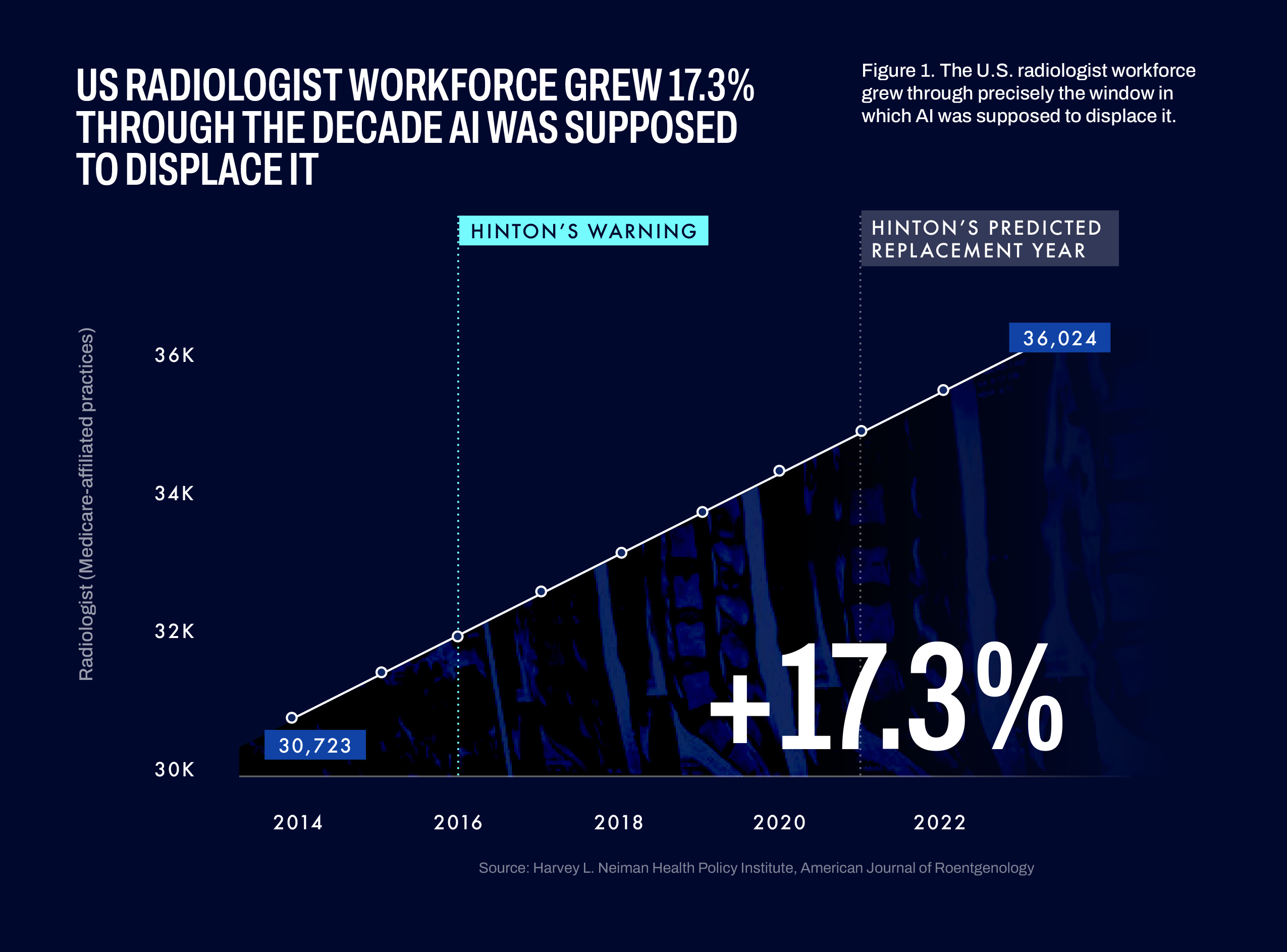
From 2014 to 2023, the number of radiologists working in U.S. Medicare-affiliated practices grew from 30,723 to 36,024, a 17.3 percent increase. During the same period, radiology residency programs expanded and filled at record rates, all while projections suggest the radiologist workforce could grow another 25 to 40 percent over the coming decades.
+17.3%
U.S. radiologist workforce growth, 2014-2023 (Medicare-affiliated practices).
+55%
Mayo Clinic radiology staff growth since Hinton's 2016 warning.
723/950
FDA-authorized AI medical devices that are radiology tools through 2024.
At the Mayo Clinic, one of the institutions most closely associated with cutting-edge AI deployment in medicine, radiology staff increased by 55 percent between 2016 and 2025, growing to more than 400 physicians.
In fact the United States now faces a radiologist shortage, not a surplus. Workforce shortages have been identified as radiology's top challenge for the past three consecutive years.
In other words, the profession AI was supposed to replace has become more essential than ever.
The mistake wasn't technological. It was conceptual. The prediction assumed that a task and a vocation are the same thing. AI can identify patterns in images. It can flag abnormalities. It can prioritize scans. Increasingly, it can help draft reports. However radiologists do much more than interpret images.
They evaluate patient history, determine appropriate imaging protocols, manage uncertainty, communicate findings to physicians, participate in multidisciplinary care teams, oversee procedures, and carry ultimate responsibility for clinical decisions. As the report explains, "the prediction missed because it misunderstood the job. It assumed the task was the job."
This is a distinction that matters. Technology often automates tasks. It rarely eliminates the broader human expertise surrounding them.
The prediction missed because it misunderstood the job. It assumed the task was the job.
Perhaps the most important finding from the report is that AI is no longer theoretical in radiolog, but is already being used in hospitals and health systems around the world. The results consistently point toward augmentation, not replacement.
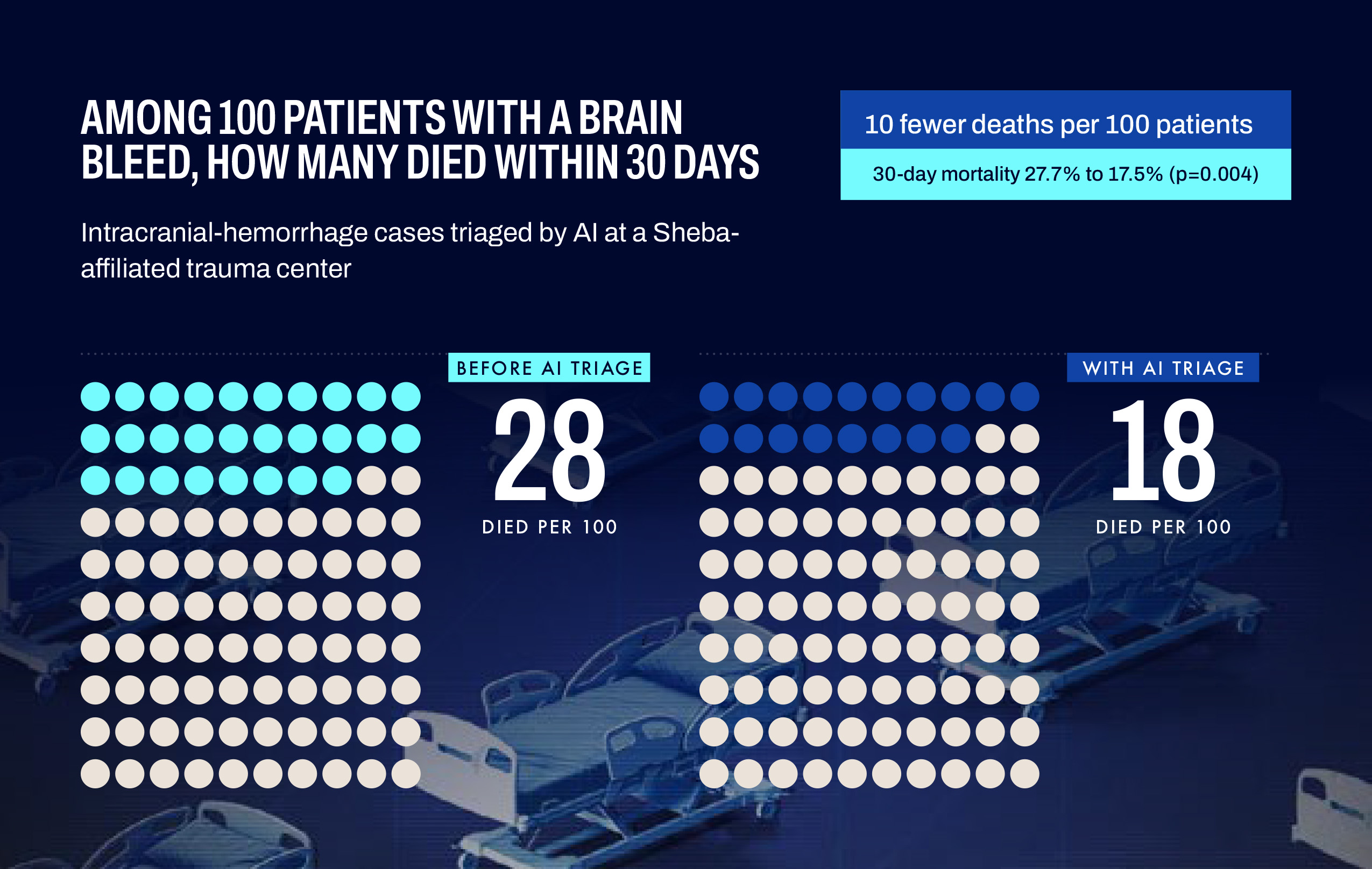
At Northwestern Medicine, generative AI tools reduced radiology documentation time by 15.5 percent while maintaining clinical accuracy. At Cedars-Sinai, AI-assisted workflows reduced patient length of stay for pulmonary embolism cases by 26.3 percent. At a Sheba-affiliated trauma center, AI-assisted triage for intracranial hemorrhage contributed to a 36.8 percent reduction in 30-day mortality.
In each case, AI handled first-pass tasks such as drafting, flagging, prioritization, or workflow optimization. The radiologist remained responsible for judgment, interpretation, and patient care.
Hospitals did not respond by eliminating specialists, instead they transformed, using scarce specialists' time more efficiently.
If this story sounds familiar, that's because we've seen it before.
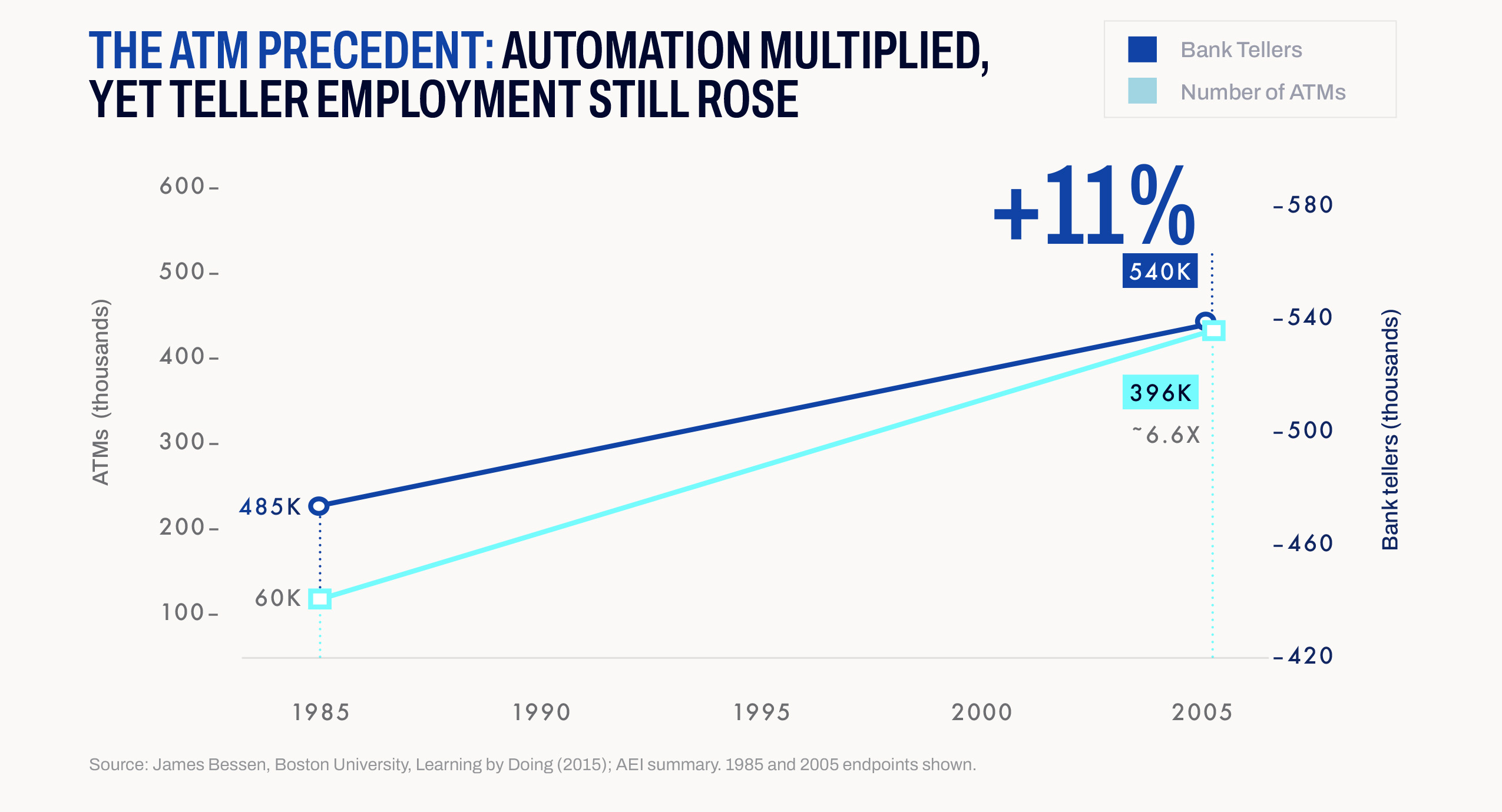
When ATMs became widespread, many predicted the disappearance of bank tellers. Instead, teller employment increased. Banks opened more branches, tellers shifted toward customer service and relationship management, and the role evolved rather than disappeared.
The same pattern played out with spreadsheets and accountants, software tools and programmers, and autopilot systems and pilots. Technology absorbed narrow tasks, increased productivity, and ultimately expanded demand for human expertise.
Radiology is following the same trajectory. AI is helping radiologists do more. It is not eliminating the need for radiologists.
None of this means AI will leave every job untouched.
The report acknowledges that some occupations will face greater disruption than others and transitions can create uncertainty for workers. New skills will be required, and workforce preparation matters.
But the radiology experience points to a broader conclusion.
The central question is not whether AI will replace workers. The central question is whether workers, employers, and educational institutions will prepare people to use AI effectively.
History suggests that when technology enters a profession, the workers who thrive are the ones equipped to work alongside it. The same appears to be true in radiology today. New roles in imaging informatics, AI governance, model validation, and AI oversight are already emerging alongside traditional clinical positions.
The lesson from radiology is not that change won't happen. It's that predictions of mass professional extinction often confuse a task with a job. Ten years ago, radiology was supposed to be the first casualty of the AI revolution. Instead, it has become one of the strongest pieces of evidence that AI can make workers more productive, more valuable, and more essential than before.
That doesn't eliminate the need for preparation. But it does suggest that the future of work may look a lot less like replacement, and a lot more like partnership.
.png)
